
If your verifier keeps returning catch-all, accept-all or risky for B2B leads, the most practical second pass for a cold-email list is BounceBan: it is built for catch-all and gateway-protected addresses, sends no test emails and costs $40 per 10,000 credits pay-as-you-go. Choose Allegrow when your list is heavy with enterprise domains and the budget allows a monthly plan, ZeroBounce when you want catch-all resolution plus an activity score inside a broader suite, and Instantly's built-in verification when the leads are going into Instantly anyway. Scrubby is the option for a stubborn remainder if you accept that its Deep mode sends real messages. MillionVerifier and Enrow include catch-all handling in ordinary verification credits.
No tool here "proves" a catch-all mailbox exists. A catch-all server answers yes to every address on the domain, so each vendor infers the answer from other signals, from observing a real send, or from activity data. Treat every result as a probability with a date on it, and decide in advance which results you will send, quarantine or skip. That policy, not the vendor's headline accuracy, decides how many bounces reach your Instantly or Smartlead campaign.
Evidence and disclosure (checked October 16, 2026): we read each vendor's current pricing, product and help pages and captured each public website. We did not run a private list through these tools, measure accuracy or bounces, or test inbox placement. Accuracy and recovery figures below are vendor claims; the one cross-vendor test we cite was run and published by Allegrow, a vendor in this list. OutboundXYZ has an affiliate relationship with Instantly and Smartlead; that relationship did not decide which tools appear here or their order. Prices are public USD list prices before tax.
This guide covers the narrow catch-all decision. For general verifier selection, read our email verification tools comparison.
Catch-all email verifiers compared
| Tool | Best fit | Verified public price and billing basis | Key limit | Main drawback | Official source |
|---|---|---|---|---|---|
| BounceBan | Second pass on catch-all and SEG-protected leads before import | $40 for 10,000 credits pay-as-you-go; $34/month for 10,000 on subscription | One credit per successful verification; guarantee only covers mail sent within 24 hours | Accuracy and coverage figures are the vendor's own | Pricing |
| Allegrow | Enterprise-heavy target lists | Starter $99/month for 5,000 contacts; add-on credits $8 per 1,000 | Starter lists catch-all resolution; gateway (SEG) resolution is listed on the $1,340/month annual plan | Highest entry cost; its benchmark is self-published | Plans |
| ZeroBounce | Catch-all resolution plus a score for leftovers, in a suite | ONE from $99/month for 10,000 credits; pay-as-you-go from $39 for 2,000 | Scoring costs one extra credit per address | Verify+ sends a test email; suite pricing mixes in other tools | Pricing |
| Instantly | Teams already importing into Instantly | 0.25 Data Credits per lead; Credits plans from $47/month for 1,500 | Monthly-plan credits expire two months after purchase | Results are Verified, Invalid or Risky only; no separate catch-all label described | Help |
| Scrubby | The remainder nothing else resolves | $0.008 per credit pay-as-you-go; Growth $97/month for 15,000 | Quick costs 1 credit; Deep costs 3 and takes up to 72 hours | Deep sends a real message to every address | Pricing |
| MillionVerifier | Cheapest first pass with built-in catch-all handling | $39 for 10,000 credits, non-expiring | Catch-all engine described as beta | Most false positives in Allegrow's rival-run study | Catch-all page |
| Enrow | Finding and verifying in one tool | Pro $87/month for 10,000 credits on monthly billing; verifier listed at $0.00217 per check | Credits are shared with email and phone finding | Little public detail on how catch-all answers are reached | Pricing |
How catch-all verification works, and why it is probabilistic
Standard verification asks the recipient's mail server whether it would accept a given address. A catch-all (accept-all) domain says yes to any address, real or invented, so that answer tells you nothing about the person. Vendors use three broad approaches to get past it:
- Signal-based inference without sending. BounceBan, Allegrow, Enrow, MillionVerifier and ZeroBounce's standard validation combine server behavior and other signals to return valid or invalid. None publishes its full method.
- Observing a real send. Scrubby's Deep Verification sends a blank message to each address from its own infrastructure and watches for bounces over 72 hours. ZeroBounce's optional Verify+ also sends an email and judges the address by the response.
- Activity scoring. ZeroBounce Email Scoring gives catch-all addresses a 1–10 score (0 is unknown) from activity data. ZeroBounce says plainly that a score does not confirm the mailbox is valid.
Each approach can be wrong. BounceBan's own support article argues that a missing bounce is weak evidence, because Microsoft 365, Google Workspace and security gateways can be configured not to return bounce notices. Scrubby argues that tools answering in seconds miss bounces that arrive days later. Both points can be true at once, which is why the result is a likelihood, not a fact.
The only multi-vendor test we found on the SERP is Allegrow's August 2026 benchmark: 10,000 addresses at 251 catch-all domains, built from 500 real people (about ten permutations each) plus 5,000 invented addresses. In Allegrow's results, Allegrow found 491 of the 500 people, ZeroBounce 467 to 470 depending on mode, and BounceBan 460, while MillionVerifier found 147 and marked 640 invented addresses valid. It is a vendor-run study: Allegrow designed it, ranked itself first and did not test Scrubby, Instantly or Enrow. Its useful contribution is the method. Ask any vendor how many real people it found, how many fake addresses it called valid, and how much it left unresolved.
How we narrowed the list
We started from the tools ranking for "catch all email verifier" and related queries, plus the specialists and add-ons cold-email teams actually put between a lead source and a sequencer. A tool qualified if its own current pages describe resolving catch-all addresses into valid or invalid (not just flagging them) and publish enough pricing to cost 10,000 checks. Listmint and Catch-all Verifier also rank and publish prices, but their public pages say little about method and Listmint's footer still reads 2024, so we left them out rather than guess. Generic verifiers that mostly flag catch-alls are covered in the broader verification guide. Order reflects use case for a cold-email import, not commission.
The seven catch-all verifiers by use case
1. BounceBan: best second pass for cold-email lists
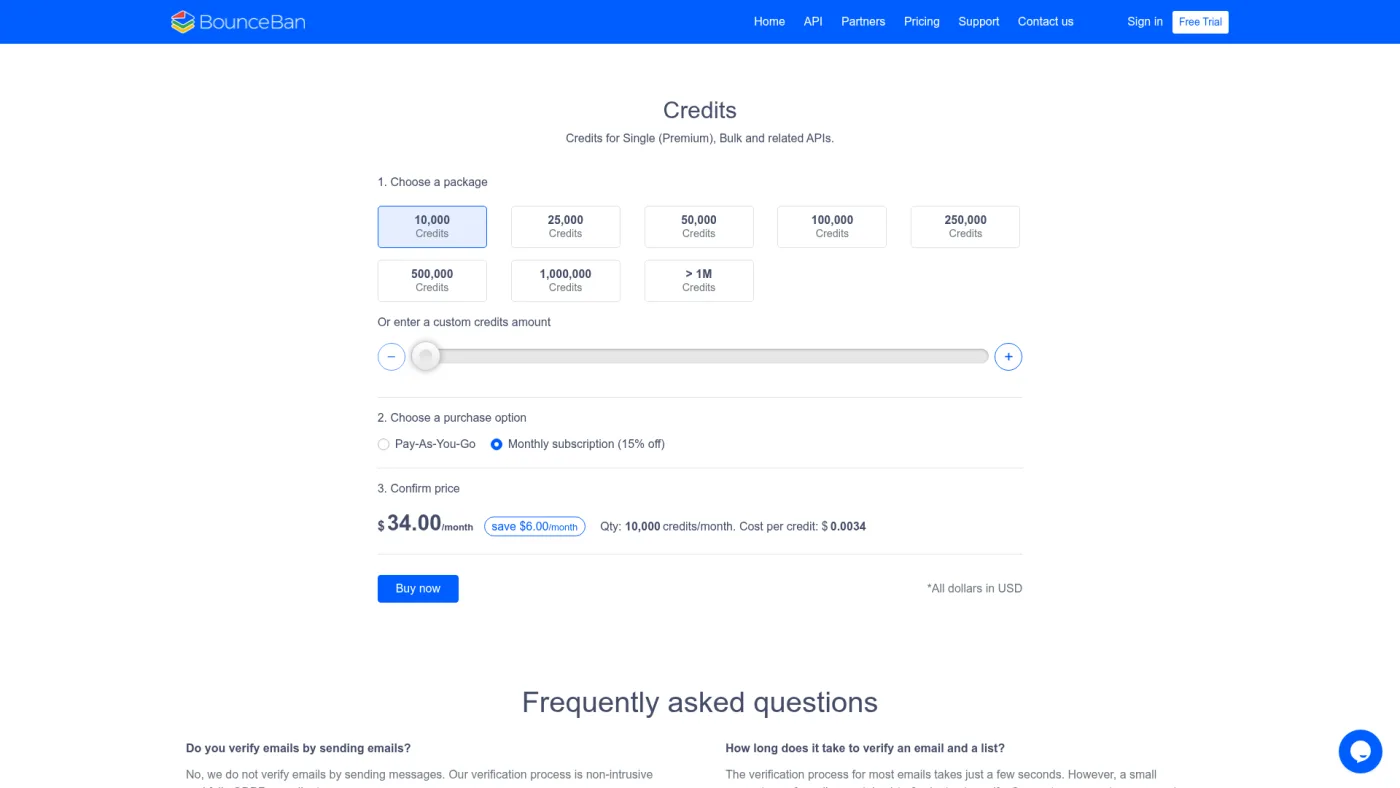
BounceBan public pricing page, captured October 16, 2026.
BounceBan is built around catch-all and Secure Email Gateway (SEG) addresses, naming Office 365, Google Workspace, Mimecast, Proofpoint and Barracuda. Its pricing page showed $40 for 10,000 credits pay-as-you-go, or $34/month on a monthly subscription, with unused credits rolling over. It charges one credit per successful verification, sends no emails to verify, and offers free single-address checks.
Its claims vary by page: the homepage says it resolves 85–95% of catch-all, greylisted or SEG-protected addresses, and an older support article says 83%+, both with 97%+ accuracy. The guarantee terms are the useful part for policy: mail must go out within 24 hours of verification, on lists of at least 1,000 unique emails across 100 domains, and only hard bounces count.
Best for: checking the catch-all and risky rows of an Apollo or database export right before an Instantly or Smartlead import. Drawback: the method is proprietary, so you are trusting vendor numbers until your own bounce data says otherwise.
2. Allegrow: best for enterprise-heavy target lists
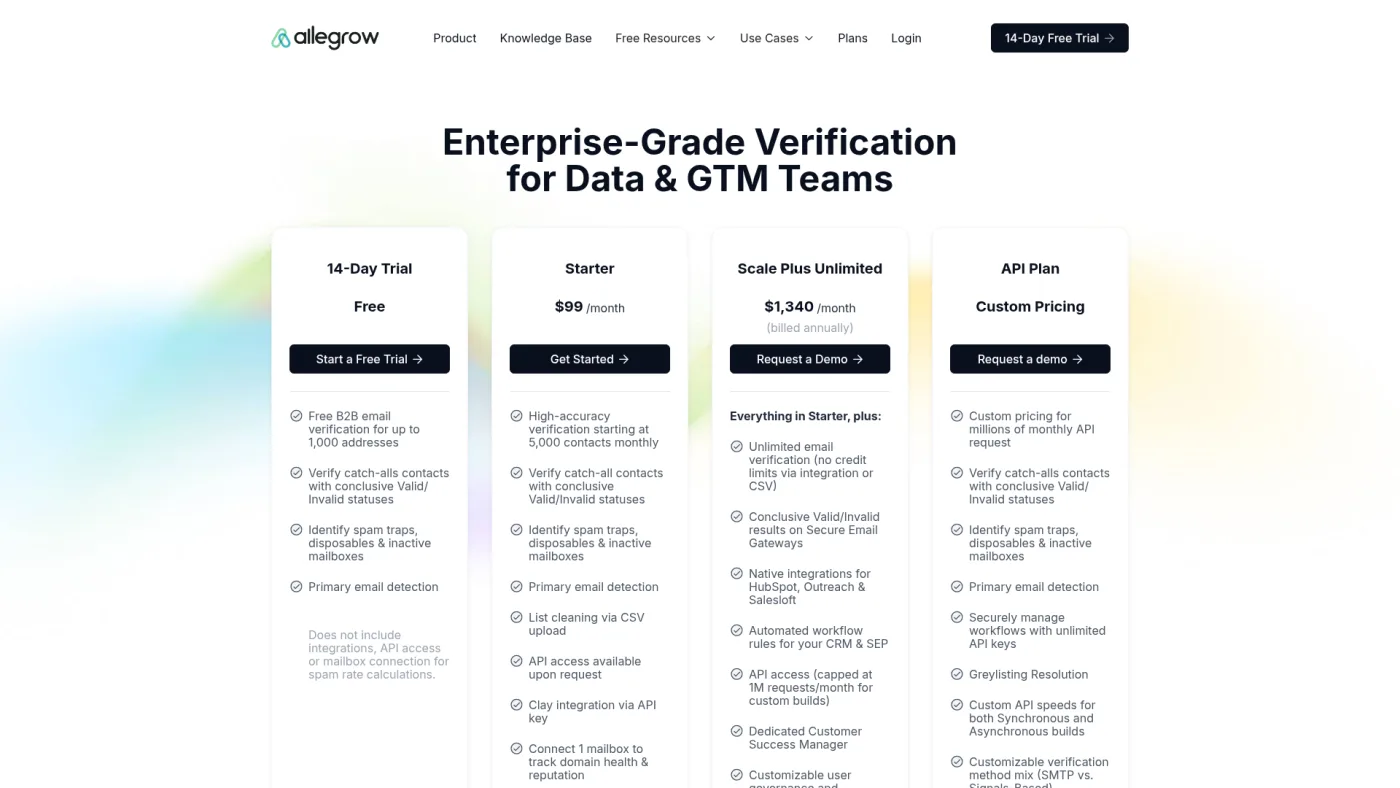
Allegrow public plans page, captured October 16, 2026.
Allegrow sells B2B verification with catch-all resolution alongside domain-health monitoring. Its plans page lists a free 14-day trial for up to 1,000 addresses, Starter at $99/month for 5,000 contacts with add-on credits at $8 per 1,000, and Scale Plus Unlimited at $1,340/month billed annually. Read the plan lines carefully: Starter promises conclusive valid or invalid statuses for catch-alls, while "conclusive results on Secure Email Gateways" and native HubSpot, Outreach and Salesloft integrations are listed on Scale Plus.
Allegrow published the benchmark above and came first in it. It says it marks records unknown when signals are absent rather than forcing a verdict, which gives you a usable quarantine bucket.
Best for: teams selling into large companies, where many targets sit on catch-all or gateway-fronted domains. Drawback: at 10,000 checks a month it costs several times a credit-pack specialist.
3. ZeroBounce: best when you also want a score for leftovers
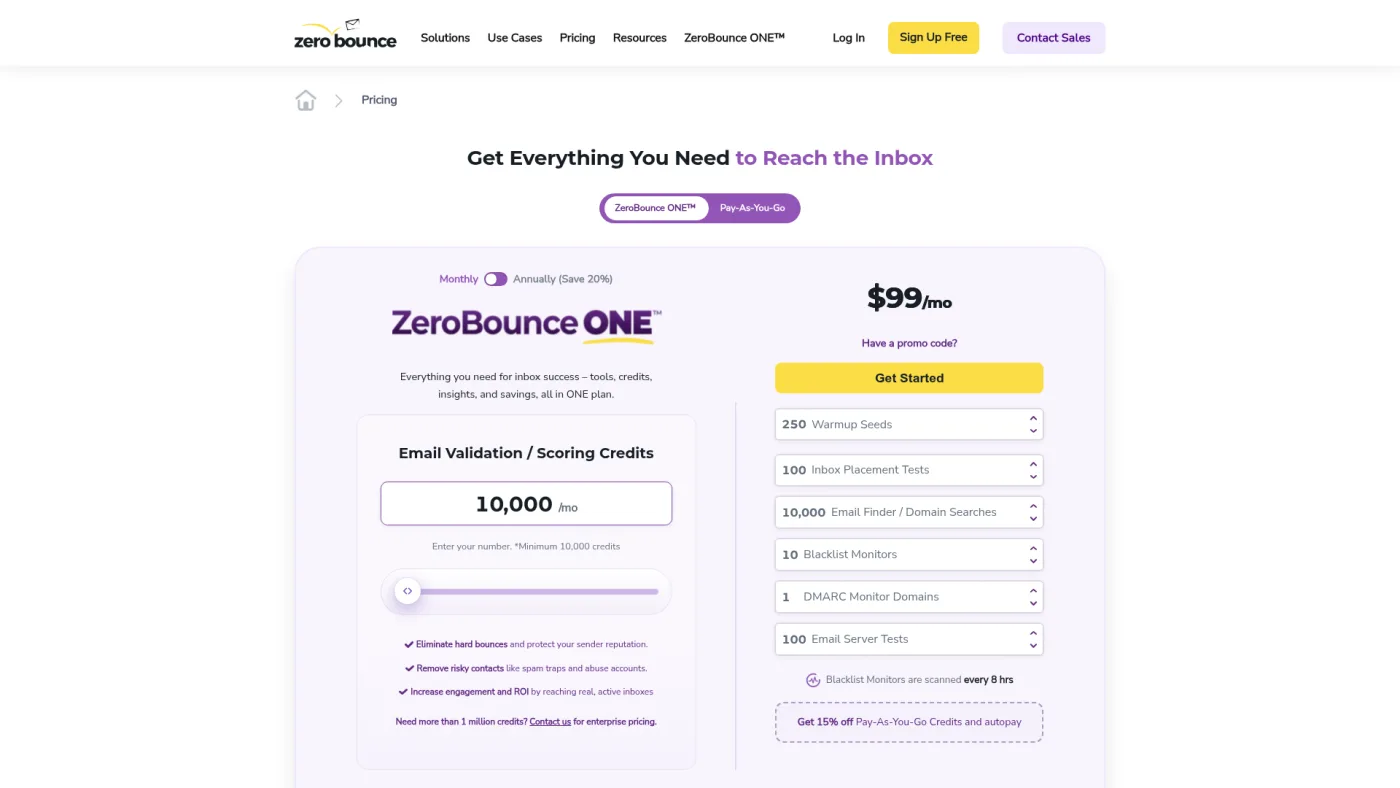
ZeroBounce public pricing page, captured October 16, 2026.
ZeroBounce's catch-all guide describes three layers: standard validation that can resolve many catch-alls on Microsoft 365, Google Workspace and major SEG platforms; optional Verify+ for eligible leftovers, which sends an email and reads the response; and Email Scoring for what remains. It keeps a domain-level catch-all indicator even when an address resolves, which is worth storing.
The pricing page showed ONE at $99/month for 10,000 credits on monthly billing and pay-as-you-go from $39 for 2,000. Unknown results are not charged. Scoring costs one credit per address on top of validation.
Best for: teams that will use the suite and want an extra signal for unresolved addresses. Drawback: in Allegrow's test, scoring changed labels but found no extra real people, and Verify+ added more false positives. That is one rival's test, but it is a reason to measure scoring on your own data before paying for it.
4. Instantly built-in verification: best if the leads go into Instantly
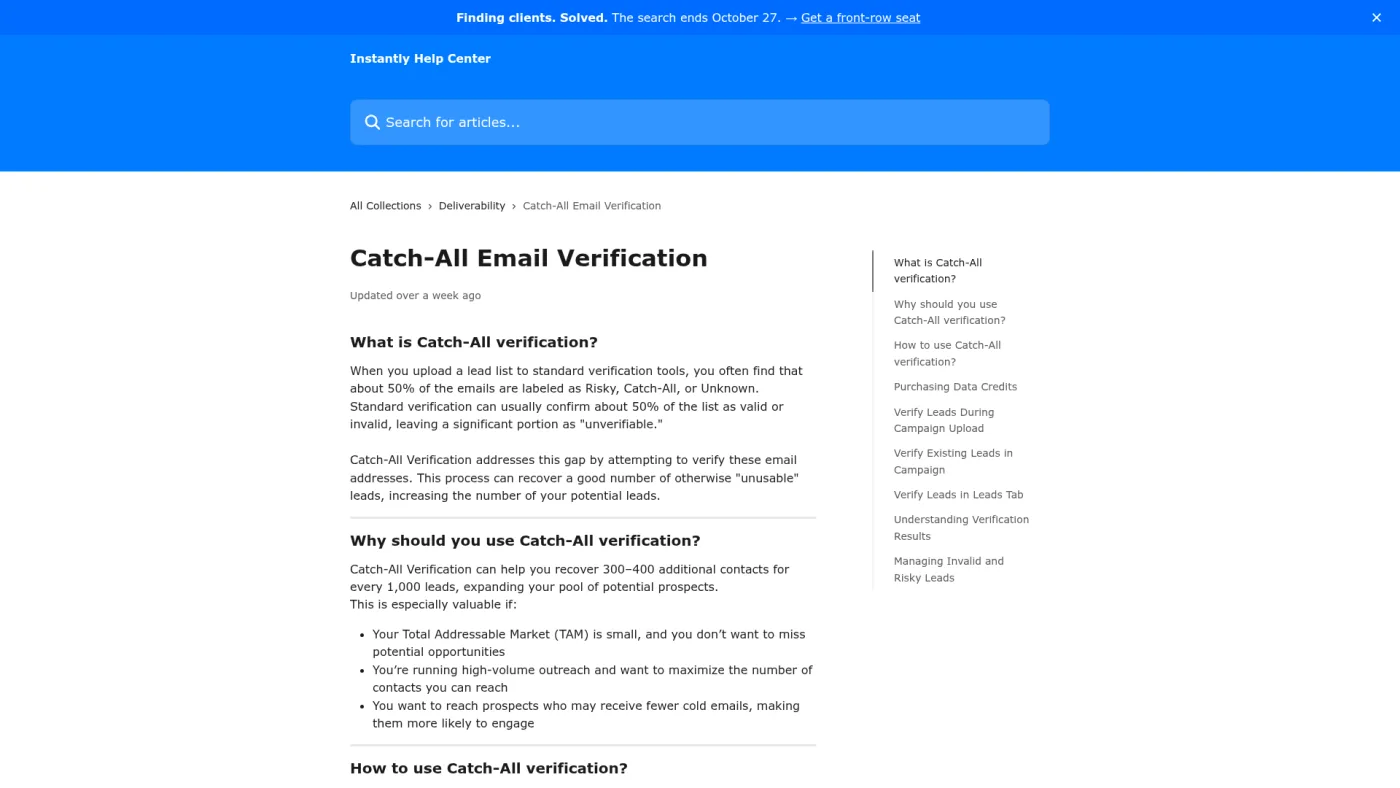
Instantly public help article on catch-all verification, captured October 16, 2026.
Instantly says catch-all verification is built into its normal lead verification, with no separate setup. Its help article puts the cost at 0.25 Data Credits per lead, available during upload ("Verify leads"), on existing campaign leads, or from the Leads tab, and automatically in SuperSearch. Results show as Verified, Invalid or Risky. Instantly claims it recovers 300–400 extra contacts per 1,000 leads; that is its own figure.
Data Credits are a separate subscription. Instantly's pricing page listed Growth Credits at $47/month for 1,500 credits and Supersonic at $97/month for 5,000 on monthly billing, and its credit guide says monthly-plan credits expire two months after purchase. Read our Instantly review for the wider product.
Best for: Instantly users who want one fewer vendor and one fewer CSV export. Drawback: no independent accuracy data, and you can't see a separate "still catch-all" bucket in the status names Instantly documents.
5. Scrubby: best for the stubborn remainder
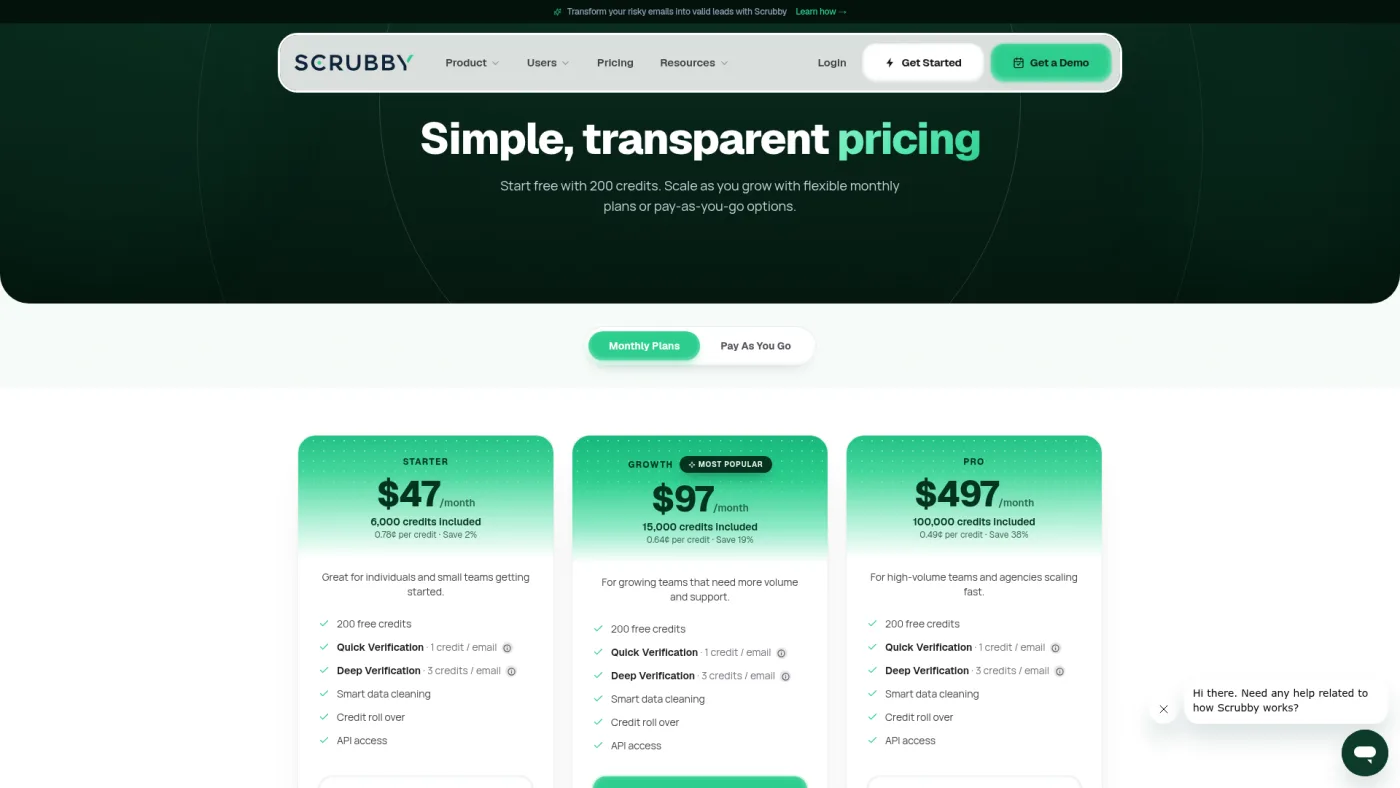
Scrubby public pricing page, captured October 16, 2026.
Scrubby offers two modes. Quick Verification costs 1 credit and, according to Scrubby, handles standard, catch-all and SEG-protected domains in minutes. Deep Verification (3 credits) sends a real blank message to every address from Scrubby's own infrastructure and watches for 72 hours, with first results after 24. Scrubby itself recommends running Quick on everything and Deep only on what comes back uncertain.
The pricing page showed Starter at $47/month for 6,000 credits and Growth at $97/month for 15,000, and its pay-as-you-go page lists a flat $0.008 per credit that never expires. All purchases are final.
Best for: small, valuable target markets where an unresolved contact is worth a three-day wait. Drawback: a vendor-sent message to a prospect is still a message they did not ask for; ask whoever owns compliance whether that is acceptable for your market before using Deep.
6. MillionVerifier: cheapest first pass with built-in catch-all handling
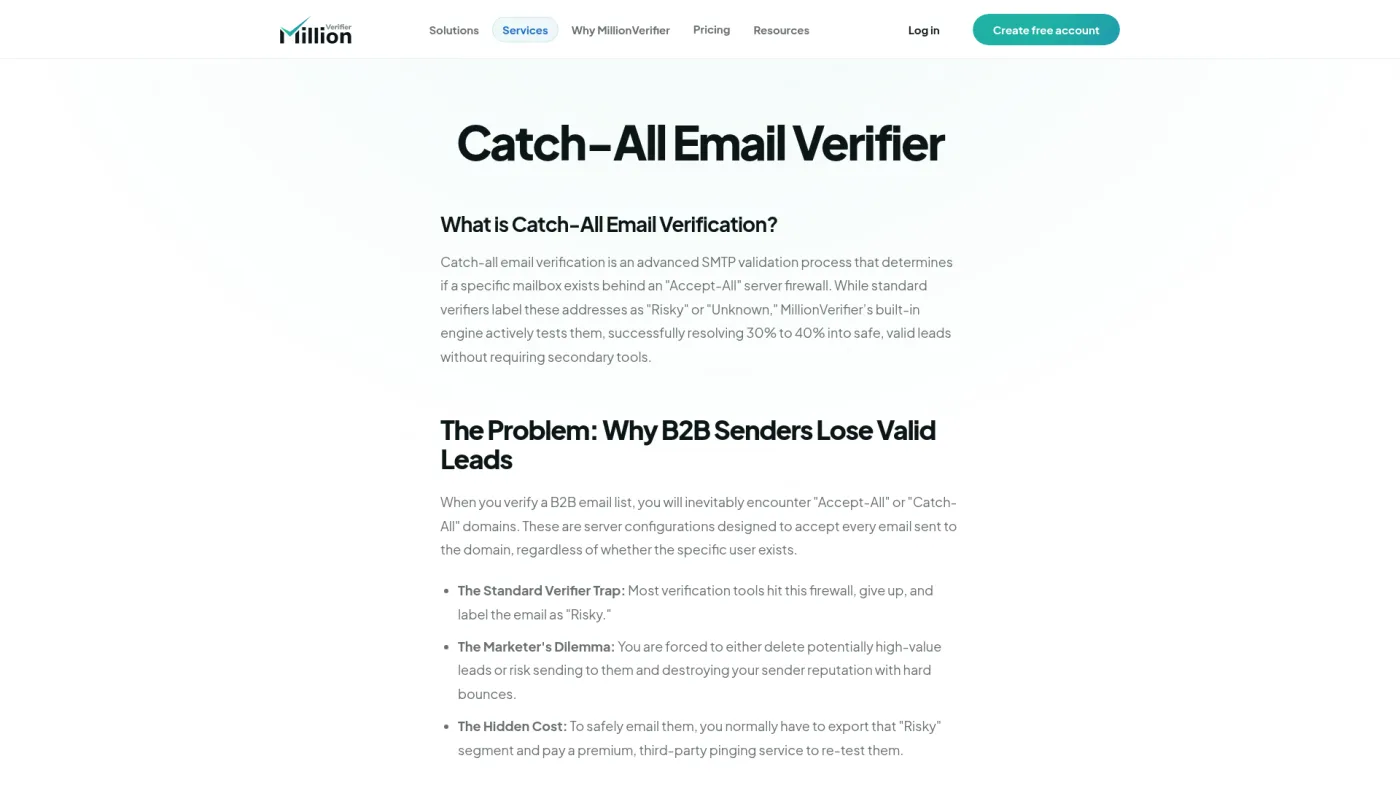
MillionVerifier public catch-all verifier page, captured October 16, 2026.
MillionVerifier's catch-all page says its standard engine resolves 30–40% of catch-all addresses into valid or invalid for the normal one credit, and does not charge for unknown or unresolved catch-all results. The homepage listed $39 for 10,000 non-expiring credits. Its help article calls the feature beta and claims 70–80% fewer catch-all and unknown results, a different metric from the product page.
Best for: a low-cost first pass on large lists, followed by a specialist on what remains. Drawback: in Allegrow's test it called 640 of 5,000 invented addresses valid. That is a competitor's study, but until your own bounce data says otherwise, treat a "valid" on a catch-all domain from this tool as a quarantine candidate rather than an automatic send.
7. Enrow: best when finding and verifying are one step
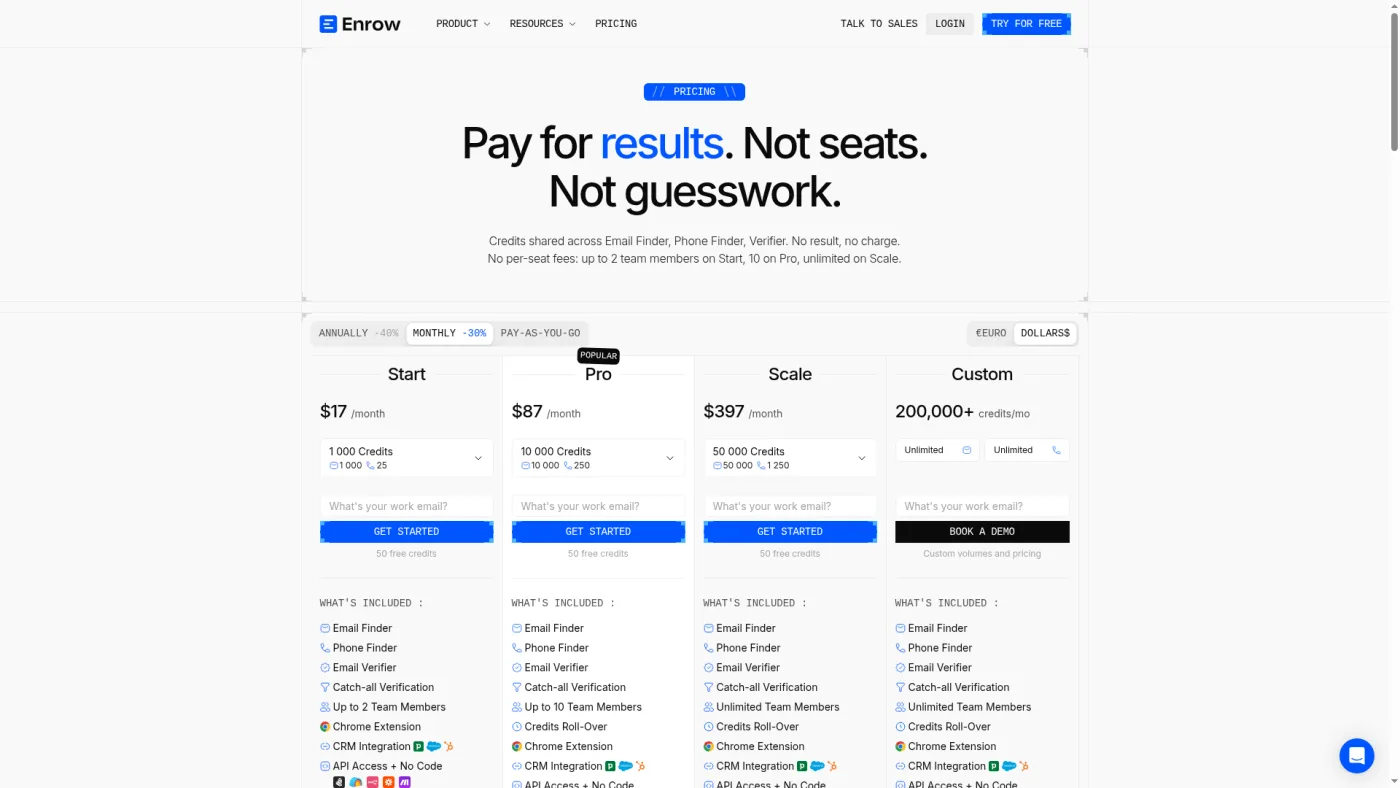
Enrow public pricing page with monthly billing selected, captured October 16, 2026.
Enrow is mainly an email and phone finder with a verifier. Its explanation of how it verifies says no email is sent, catch-all verification is included in every verification at no extra cost, and the answer is always valid or invalid, never "maybe". The pricing page showed Pro at $87/month for 10,000 credits on monthly billing, with the verifier listed at $0.00217 per check on that plan, which works out to a quarter credit per check.
Best for: teams that find addresses and want them checked in the same step, especially from the email finders category. Drawback: a tool that never returns "unknown" leaves you no quarantine signal, and Enrow describes its catch-all step only as "deeper checks".
What 10,000 catch-all checks cost
Assume you have 10,000 addresses that a first verifier returned as catch-all, risky or unknown, and you want a second opinion in one month before import. The table uses the smallest public option on October 16, 2026 that covers 10,000 checks. Free trial credits, taxes and later price changes are excluded. This is a procurement model, not a prediction of how many contacts each tool will recover.
| Tool | Units needed | Smallest public option covering it | Cash outlay | Notes |
|---|---|---|---|---|
| MillionVerifier | 10,000 credits | 10,000-credit pack | $39 | Unresolved catch-alls not charged |
| BounceBan | 10,000 credits | Pay-as-you-go pack | $40 | $34 if on monthly subscription |
| Scrubby Quick | 10,000 credits | Pay-as-you-go at $0.008 | $80 | Deep on all 10,000 would be 30,000 credits ($240) |
| Enrow | 2,500 credits | Pro, monthly billing | $87 | $21.70 of that allocation at the listed check price |
| Instantly | 2,500 Data Credits | Supersonic Credits, monthly | $97 | Growth's 1,500 credits fall short; credits expire after two months |
| ZeroBounce | 10,000 credits | ONE, monthly | $99 | Scoring the leftovers adds one credit each |
| Allegrow | 10,000 contacts | Starter plus 5,000 add-on | $139 | $99 + 5 × $8 |
The cheapest cell is not the answer. Check unit rules (who charges for unknowns, whether credits expire, whether leftover allocation gets used) and cost per accepted contact: if one tool turns 6,000 of your 10,000 into confident sends and another 3,000, the cheaper invoice can be the worse buy. Run a 500 to 1,000 row sample through two finalists first.
Turn results into a send, quarantine or skip policy
Write the policy down before results arrive, then route every row through it.
| Result after your catch-all pass | Default action | What to record |
|---|---|---|
| Valid or deliverable, resolved on a catch-all domain | Send, in a separate catch-all segment, soon after the check | Vendor, check date, domain catch-all flag |
| Invalid or undeliverable | Skip and suppress | Reason and source, so you don't buy it again |
| Still catch-all, risky or unknown | Quarantine: find another contact or retry later | Retry date and vendor response |
| Score only, such as a ZeroBounce score | Quarantine; a high score is a reason to look further, not a send | Score and date |
| "Valid" from a send-based check with no bounce | Send in the catch-all segment and watch bounces closely | Mode used and observation window |
A separate segment keeps catch-all bounces visible instead of hiding them in a campaign average. Check close to send time: BounceBan's guarantee only covers mail sent within 24 hours, a hint at how quickly these answers age. Our guides to soft vs. hard bounces and cleaning up an email list cover what to do when bounces come back anyway.
In Instantly: Instantly's help center says Invalid and Risky leads are not contacted by default. Sending to Risky leads requires the Enable risky emails box under Settings → Advanced settings → Sending rules → Allow risky emails. Leave it off in your main campaign. If you deliberately test quarantined rows, do it in a separate campaign you can stop quickly. A high-bounce auto-pause is covered in our Instantly campaign not sending guide.
In Smartlead: Smartlead's verification add-on (from 6,000 credits for $15) identifies invalid and unknown emails, and after verification a launched campaign sends to valid and catch-all leads. Catch-alls are sendable by default there, so run your catch-all pass before upload and import only the rows your policy approves. Smartlead also says leads can't be verified once a campaign is live. See our Smartlead review for the rest of the platform.
In a July 2023 video, Jan's minimal cold-email stack put a verifier (MillionVerifier at the time) between the lead database and Instantly, warning that too many guessed, wrong addresses (he cited roughly five percent) cause spam-filter trouble. That video carries an Instantly affiliate disclosure, and the figure is a 2023 rule of thumb, not a current threshold or a catch-all test. In an August 2024 video he described his agency's back end, where uploaded lead lists were verified, split and excluded automatically. That is the durable lesson: routing is a system you build once, not a judgment call per CSV. For broader bounce work, see the reduce email bounces page.
Frequently asked questions
Can you verify a catch-all email address?
Not with certainty. A catch-all server accepts mail for any address, so tools infer the answer from other signals, observe a real send, or score activity. Many addresses can be resolved to a confident valid or invalid; some stay unresolved with every tool.
Is it safe to send cold email to catch-all addresses?
Treat resolved catch-alls as riskier than ordinary valid addresses, because the verdict is inferred, and unresolved ones as riskier still. Send resolved ones in a separate segment soon after checking, quarantine the rest, and watch hard bounces by segment rather than campaign-wide.
How much does catch-all email verification cost?
At October 16, 2026 list prices, putting 10,000 addresses through a tool ranged from $39 (MillionVerifier) to $139 (Allegrow Starter plus add-on credits) for one month. Specialists sell credit packs; Instantly charges a quarter credit per lead from a monthly allocation, and Enrow's listed check price works out the same way.
Does Instantly verify catch-all emails?
Yes. Instantly says catch-all verification is part of its standard lead verification at 0.25 credits per lead, and Risky and Invalid leads are skipped unless you enable risky sending in the campaign's sending rules.
Why did a "valid" catch-all address still bounce?
The verdict was an estimate, the mailbox may have changed since the check, or the bounce was about your sender or content rather than the address. Read the bounce reason before blaming the verifier, and report clear misses to the vendor.