
If you monitor six to 25 active sending domains and want a published price with room for a team, URIports Stone is the clearest starting point in this comparison. It includes 25 domains and team access for $33 per month on monthly billing. If you need visibility but are not ready to pay for managed enforcement, Valimail Monitor offers free monitoring across unlimited domains. For up to five active domains, compare PowerDMARC Basic when hosted authentication and longer history matter. These are different recommendations for different jobs, not measured deliverability winners.
The first question is whether you need a paid monitor at all. A DMARC record lookup can check a published record. A monitoring service receives and organizes ongoing aggregate reports so you can notice a newly failing sender or an unexpected source across the portfolio. If you own only one low-volume domain and someone already reviews its reports, start with a free option. Buy when domain inventory, ongoing review, alerts, access control or enforcement work has become a real operational task.
Evidence and disclosure (reviewed October 1, 2026): We checked the six vendors' public product and pricing pages and captured their public websites. We did not connect private domains, run the same traffic through every product or test inbox placement. A screenshot is a website capture, not proof of using the product. Vendor claims about detection and enforcement remain vendor claims. This article links directly to official vendor pages; its ordering follows the stated use cases, not affiliate commission. OutboundXYZ may use affiliate links elsewhere on the site.
DMARC monitors for multiple domains compared
Prices below are USD public list prices before applicable tax. A monthly equivalent billed annually is not a month-to-month price. A plan's domain count means its published allowance for active monitored or sending domains; verify how your subdomains and parked domains are counted before checkout.
| Tool | Best fit | Verified entry price and billing | Relevant domain and usage limit | Main drawback | Official source |
|---|---|---|---|---|---|
| URIports | Six to 25 domains with technical team access | Stone $33/month monthly; $30/month equivalent, $360 billed annually | 25 domains, 500,000 reports/month, 30-day retention | Report count is a different meter from email volume; history is short at this tier | Pricing |
| Valimail Monitor | Free portfolio visibility before managed enforcement | Free; Enforce requires a quote | Vendor says Monitor has no domain or email-volume limit; policy and sender management belong to Enforce | Monitoring does not make authentication changes for you | Monitor, pricing |
| PowerDMARC | Two to five active domains needing hosted authentication | Basic $15/month monthly; $12/month equivalent billed annually at the shown 100,000-compliant-message selection | Five active domains, two users, one year of history; price changes with message volume | Additional domains require a sales quote; hosted SPF is an add-on | Pricing policy |
| EasyDMARC | Small portfolio needing guided remediation and alerts | Plus $44.99/month monthly or $35.99/month equivalent billed annually; Premium $89.99/$71.99 | Plus: two domains, 1.2 million emails/year, three months of history; Premium: four domains, one year | A larger active-domain portfolio requires a quote | Business pricing |
| dmarcian | IT-led authentication work with sender investigation | Basic $24/month monthly; Plus $240/month monthly; Enterprise $600/month monthly | Basic: two active domains; Plus: eight; Enterprise: 15. Message allowances and retention rise by tier | Ten active domains cross into Enterprise list pricing unless a custom quote fits | Pricing |
| DMARC Digests | Simple per-domain budgeting and emailed summaries | $14/month per domain, after a 14-day trial | 60 days of activity; no portfolio bundle advertised on its public page | Ten domains cost $140/month before tax; less emphasis on portfolio controls | Product and pricing |
What we compared
We looked for six things a multi-domain operator can verify before buying: (1) active-domain allowance, (2) the unit of usage being billed, (3) enough history to spot drift, (4) a way to separate or share domain access, (5) help moving from observation to remediation, and (6) a public price or an honest quote boundary. We did not assign accuracy scores: public pages do not establish a comparable detection test. All six vendors offer meaningful DMARC report monitoring, but they solve different amounts of the surrounding work.
This page owns a portfolio software buying decision. For protocol basics, read SPF, DKIM and DMARC explained and email authentication protocols. If the issue is bad addresses in a prospect list rather than domain authentication, use our email verification tools comparison.
The six tools, by buying situation
1. URIports — best published bundle for a growing technical portfolio
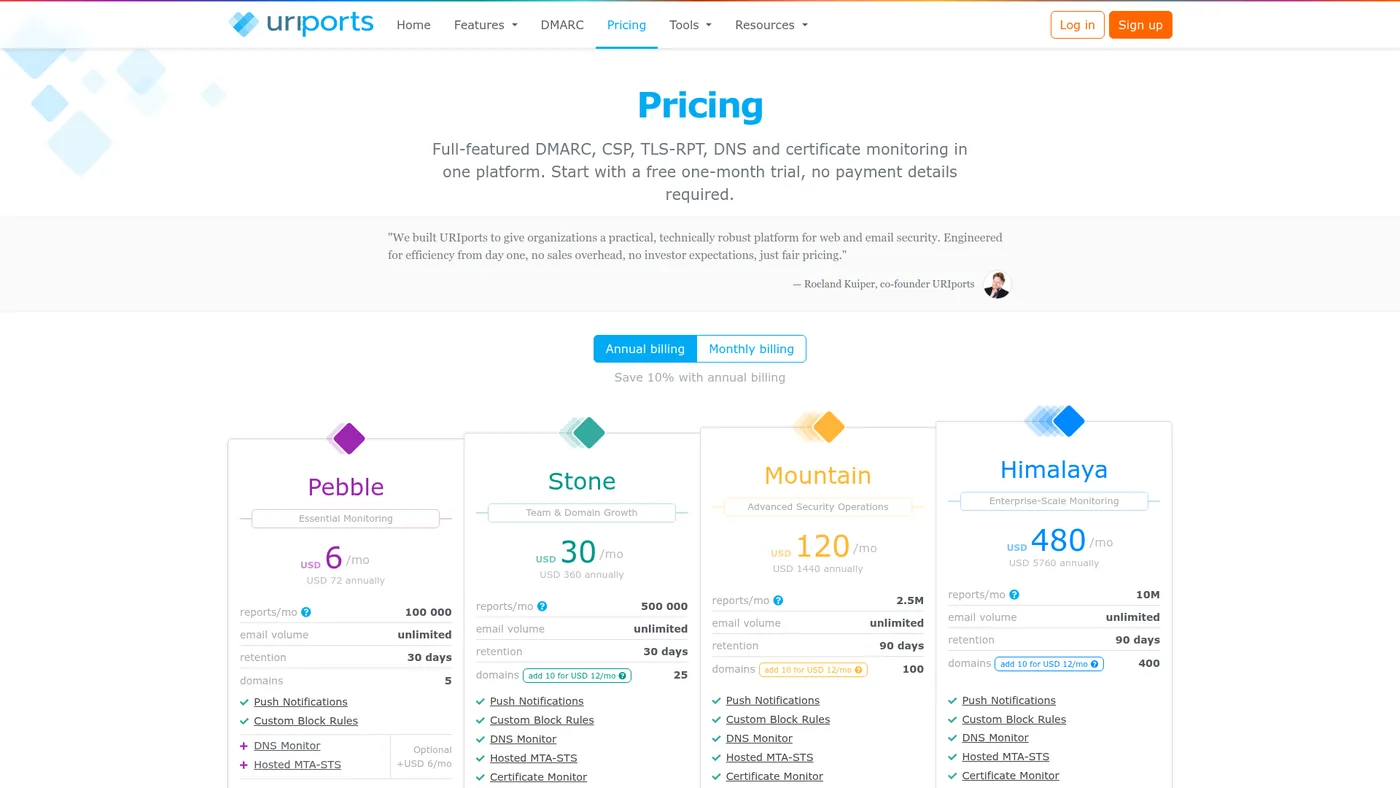
URIports public pricing page, captured October 1, 2026.
URIports is the strongest fit here when a small operations team has grown beyond five sending domains but does not need a negotiated enterprise contract. Its pricing page shows Stone at $33 per month on monthly billing, or $360 per year ($30 monthly equivalent), with 25 domains, 500,000 reports per month, 30-day retention, team access, DNS and certificate monitoring. The vendor describes domain labels, client-scoped team access, an API on Stone and above, and ten-domain add-on packs for a separate charge. That makes the plan particularly relevant to an agency or an internal security team with distinct domain owners.
Do not confuse URIports' report quota with the number of outbound emails you send. The vendor explains its report meter: receivers aggregate activity into reports, and the number of reports can vary with receiver and source mix. Trial traffic is a better sizing input than outbound sends alone. Also, its 30-day entry-level history may be too short for slow-moving investigations or audit needs.
Choose it when: six to 25 domains, team access and a predictable published domain bundle matter. Pass when: your procurement requires longer default retention, or you want the vendor to operate the full enforcement project.
2. Valimail Monitor — best free visibility across many domains
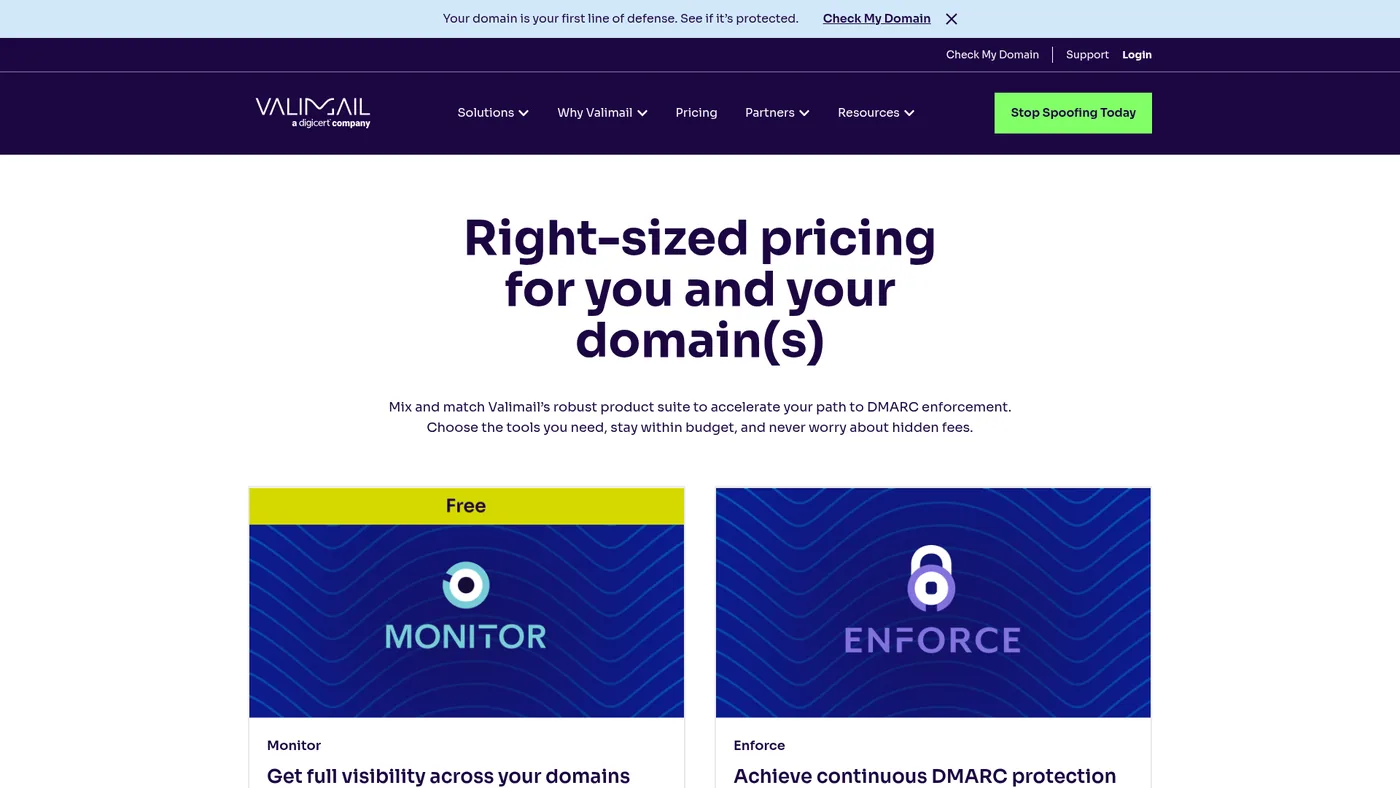
Valimail public pricing page, captured October 1, 2026.
Valimail says its free Monitor product turns aggregate DMARC data into identified sending services and domain-level pass/fail visibility. Its product overview describes unlimited domain visibility, and its own explanation says Monitor has no domain or email-volume limit. For a scattered sending portfolio, this is a credible way to inventory sources before deciding whether a paid platform is justified.
The boundary matters. Valimail's Monitor setup guide says you must point aggregate reports to its service through a DNS change and that Monitor provides visibility, not the ability to manage DMARC policy and senders through SPF and DKIM configuration. Those management features belong to Enforce; current Enforce pricing asks you to contact sales. A free dashboard can reveal the problem while leaving your team responsible for the change.
Choose it when: you want to see activity across many domains before committing budget. Pass when: the primary need is a published paid price for automated policy work or a fully specified MSP workflow.
3. PowerDMARC — best compact suite for up to five active domains
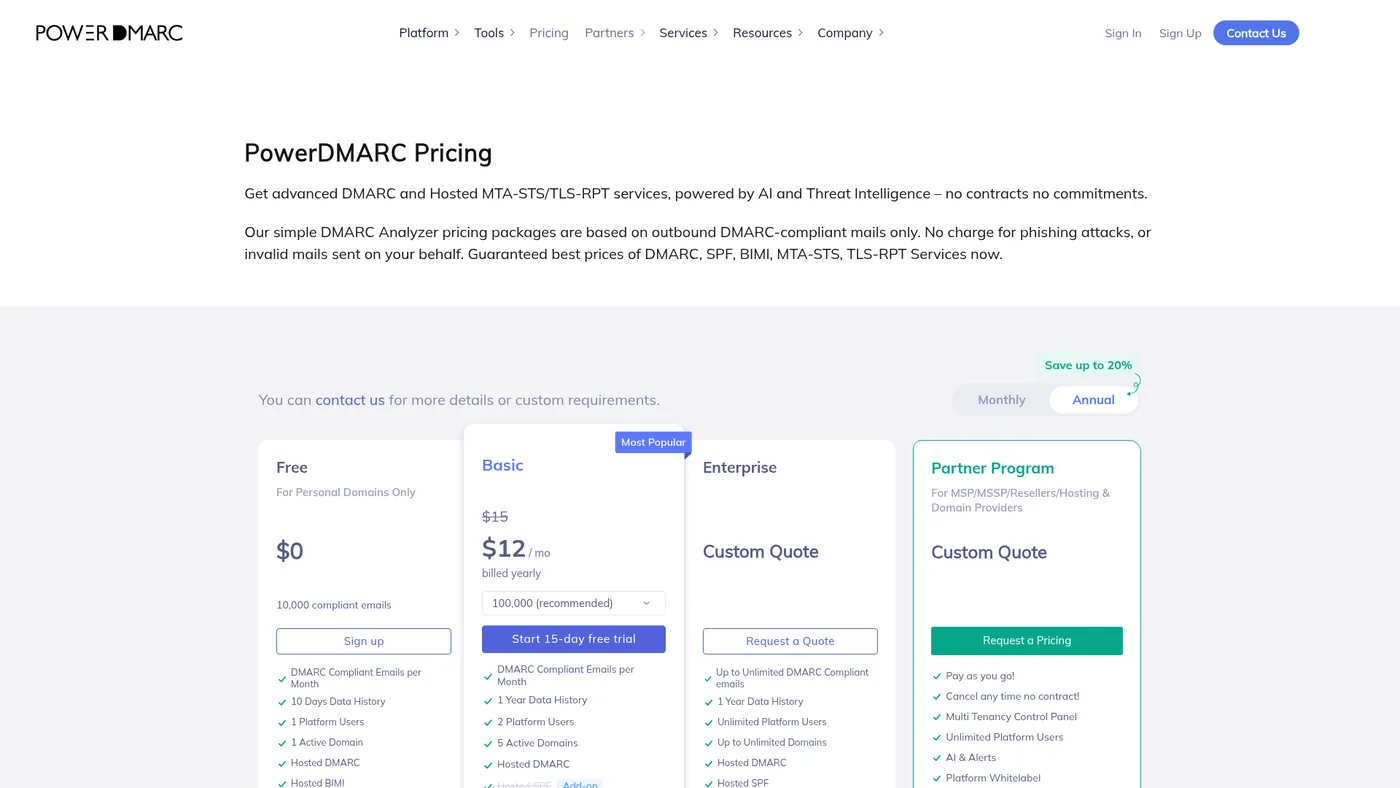
PowerDMARC public pricing page, captured October 1, 2026.
PowerDMARC's public pricing policy puts five active domains, two platform users and one year of data history on Basic. The page displayed $15 per month or $12 per month equivalent on annual billing for the selected 100,000 compliant messages per month. The offering also includes hosted DMARC, MTA-STS and TLS reporting; hosted SPF is marked as an add-on. Its free tier is for personal domains only, so do not budget it for a commercial sending portfolio.
The appealing entry price needs a second look if your portfolio will exceed five active domains or if compliant-message volume changes. PowerDMARC bases pricing on legitimate DMARC-compliant mail reported to the platform. Its FAQ directs buyers who need more domains to contact sales. Ask for one quote with your actual active-domain and message counts rather than multiplying the five-domain headline price.
Choose it when: you have up to five active domains and want monitoring beside hosted authentication features. Pass when: the number of active domains is already beyond five and a self-serve total price is essential.
4. EasyDMARC — best guided path for a small portfolio
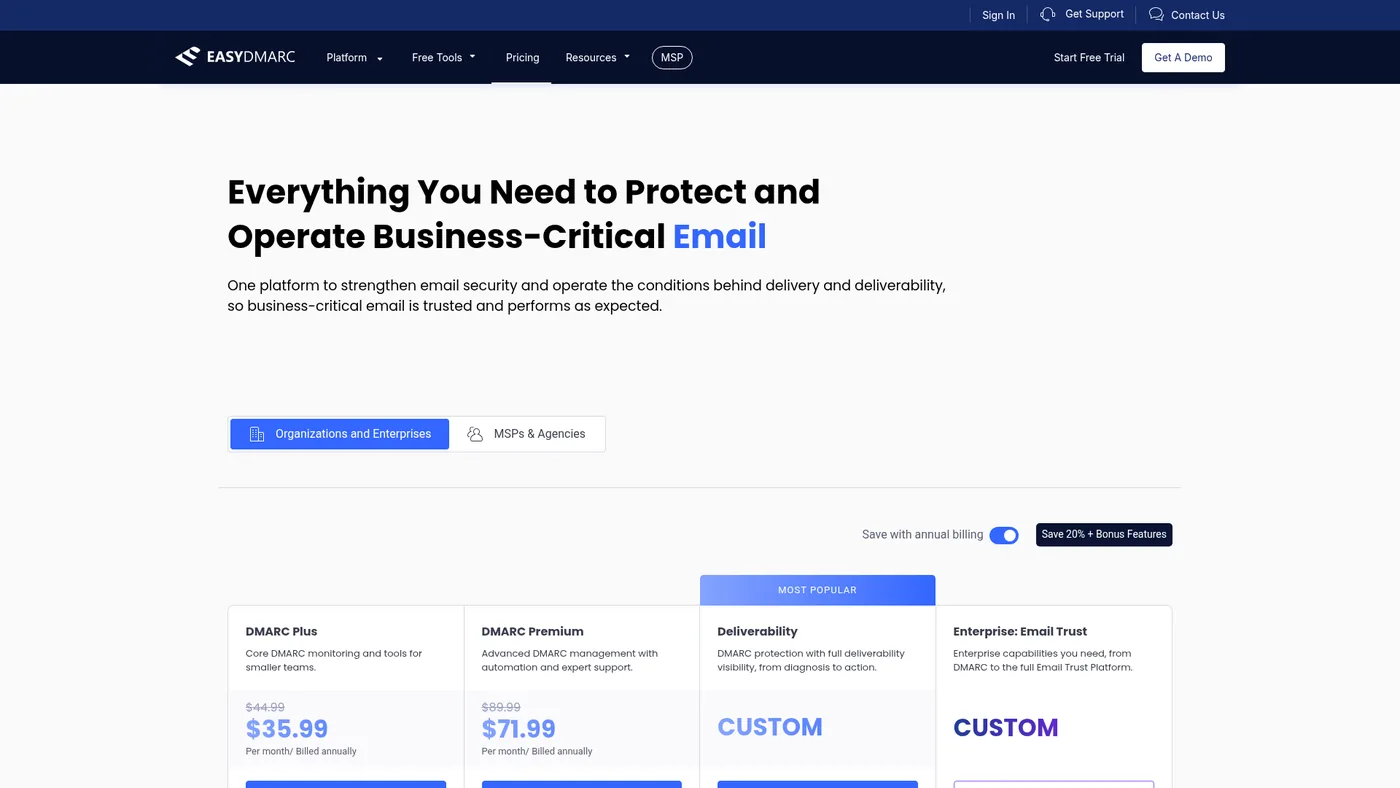
EasyDMARC public pricing page, captured October 1, 2026.
EasyDMARC's current business pricing lists Plus at $44.99 per month on monthly billing or $35.99 monthly equivalent billed annually, with two domains, 1.2 million emails per year at its initial selection, and three months of history. Premium lists $89.99 monthly or $71.99 monthly equivalent billed annually, with four domains, one year of history, proactive alerts and EasySPF. The pricing page offers higher email-volume selections; do not assume the entry price applies to those selections.
This is a better comparison for a few domains needing guided authentication work than for a 15-domain rotation. The published business tiers stop at four included domains. EasyDMARC says buyers who need extra domains should contact sales; its broader Deliverability and Enterprise offerings are custom priced. Its domain billing explanation distinguishes actively sending domains from parked ones, which is worth checking against your inventory.
Choose it when: a two- to four-domain team values remediation guidance and alerts. Pass when: you need a published all-in price for many active domains.
5. dmarcian — best for an IT-led remediation project
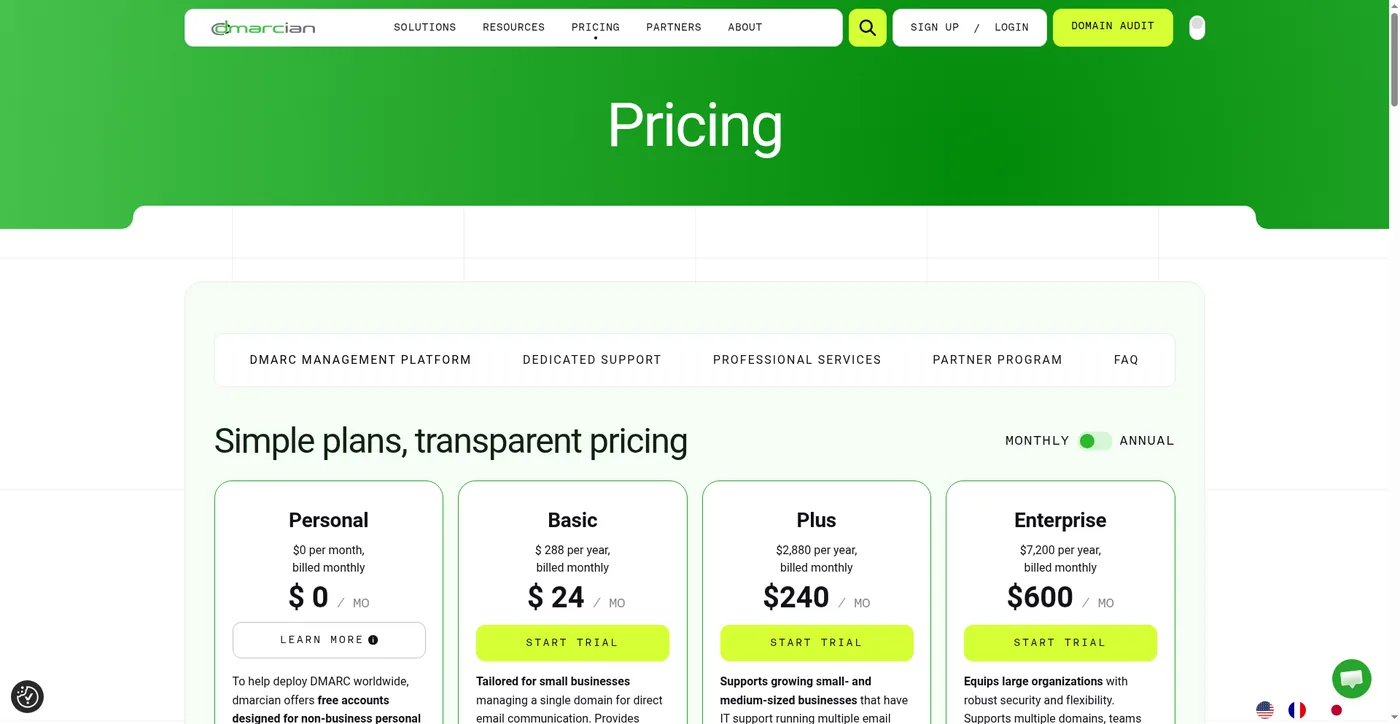
dmarcian public pricing page, captured October 1, 2026, after dismissing the cookie dialog.
dmarcian's plan table separates active sending from inactive domains and sets clear steps: Basic covers two active domains, 100,000 DMARC-capable messages per month and three months of history; Plus covers eight, one million and one year; Enterprise covers 15, five million and unlimited history. The public monthly prices are $24, $240 and $600 respectively; annual billing lowers the monthly equivalents to $19.99, $199 and $499. Its Personal plan is expressly for non-business use.
This structure suits a team that will investigate sender identities and work through enforcement, and can justify paying for history and controls. It is a poor bargain if you only want to check a handful of quiet domains. A ten-active-domain portfolio exceeds the published Plus allowance, so the list-price comparison points to Enterprise. dmarcian explicitly offers custom proposals for different domain or volume needs; get that quote before treating $600 as the only possible price.
Choose it when: authentication remediation is a staffed IT project. Pass when: your main constraint is low-cost portfolio visibility.
6. DMARC Digests — best simple per-domain budget
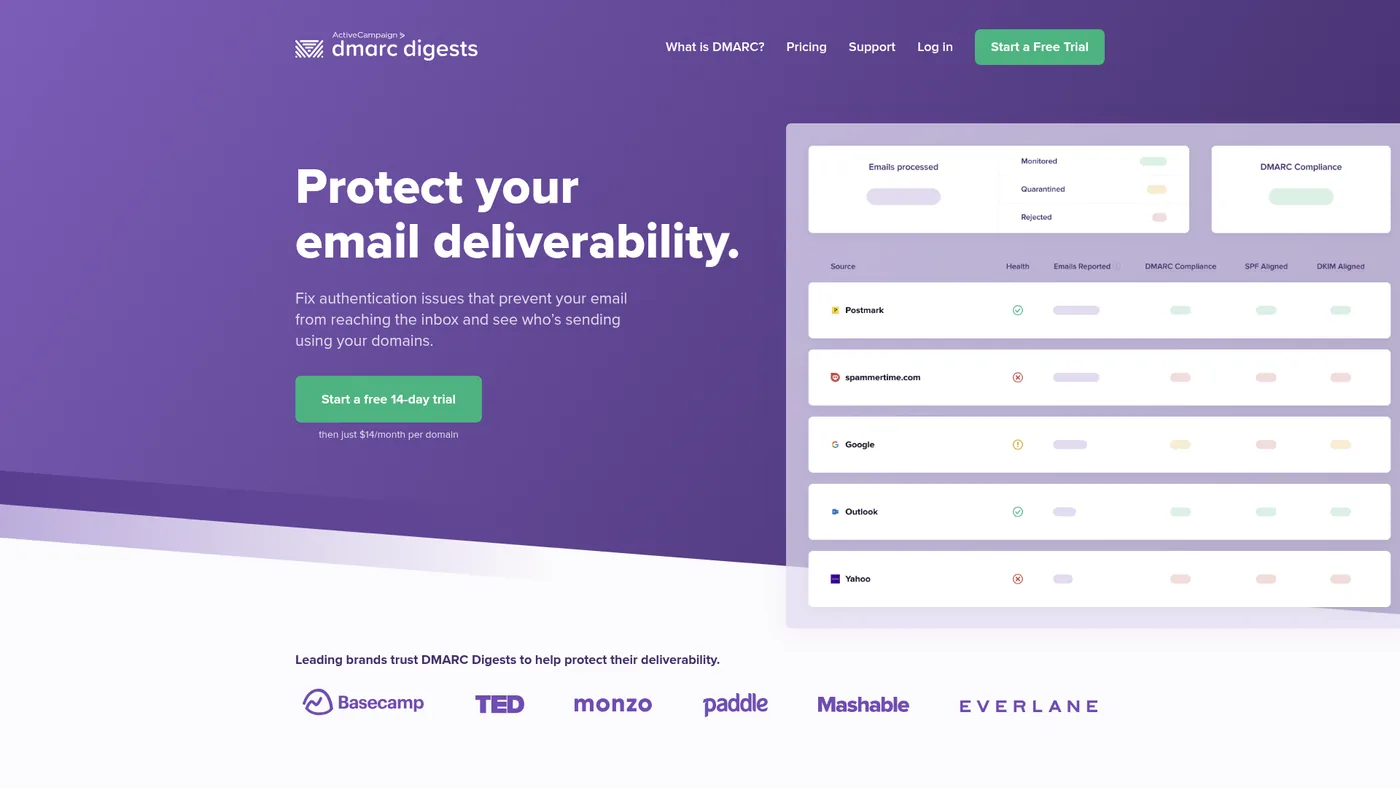
DMARC Digests public homepage, captured October 1, 2026.
DMARC Digests keeps the calculation straightforward: its public site says $14 per month per domain after a 14-day trial, with 60 days of activity, weekly and monthly email digests, troubleshooting guidance and team accounts. You can know the domain-based bill before talking to sales. The straightforward model is useful when the portfolio changes and each domain has an identifiable owner.
The same formula becomes expensive as domain count grows: ten domains at the advertised rate are $140 per month before tax. The page does not advertise a discounted portfolio bundle or the granular client access controls that an MSP may need. Confirm those requirements with the vendor instead of assuming they exist.
Choose it when: clear per-domain billing and human-readable summaries matter most. Pass when: you have enough domains that a bundle is materially cheaper, or you need documented tenant-level segregation.
A ten-domain decision aid
Assume ten active sending domains, one organization, two people who need access and a full month of monitoring. This is a price and fit exercise, not a claim that the products provide identical functions. Check your real report or compliant-message volume during a trial, and ask whether every domain is truly active. All values are public USD list prices checked October 1, 2026, before tax.
| Path | Public monthly cost for this scenario | What the price does and does not establish |
|---|---|---|
| Valimail Monitor | $0 | Free visibility across unlimited domains; your team still owns policy and sender remediation. Enforce is quote-based. |
| URIports Stone | $33 monthly, or $30 monthly equivalent billed annually | Ten domains fit the 25-domain bundle; 500,000 reports per month and 30-day retention still need validation. |
| DMARC Digests | $140 monthly (10 × $14) | Transparent per-domain arithmetic and 60-day activity; verify collaboration controls. |
| dmarcian Enterprise | $600 monthly, or $499 monthly equivalent billed annually | Plus ends at eight active domains. Enterprise includes up to 15 and richer controls; request a custom quote if a lower tier plus added domains could fit. |
| PowerDMARC or EasyDMARC | Quote required for ten active domains | Public Basic/Premium domain allowances stop at five/four; do not extrapolate a one-domain unit price. |
The cheapest sticker price is not automatically the cheapest useful workflow. If one person must manually reconcile ten dashboards, or a short retention period hides a failure, add that labor and risk to the decision. Conversely, a large enforcement suite is unnecessary if you only need a dependable view of aggregate reports.
Checklist before moving all your domains
- Inventory active, parked and subdomains. Ask each vendor which ones count toward the paid allowance. A single company may have ten registrations but only four domains sending mail.
- Record every legitimate sender per domain. Include workspace mail, CRM, sequencing, marketing, support and transactional systems. An unknown source needs investigation, not automatic approval.
- Confirm the meter. URIports counts reports; PowerDMARC and dmarcian describe compliant or DMARC-capable messages; DMARC Digests uses a per-domain rate. These cannot be compared by dividing one headline price by ten.
- Confirm access and retention. If clients or business units must see only their own domains, get an explicit demonstration of scoping. If you need an audit trail, check history before committing.
- Plan a reporting handoff. Changing a
ruadestination in DNS affects where aggregate reports arrive. Keep a record of the old and new destinations and verify reports arrive for each domain. Do not change enforcement policy as part of a billing comparison. - Assign a response owner. A monitor can surface SPF or DKIM alignment failures, but someone still needs to trace the sender and make the safe fix. Use a DMARC checker to inspect the published record, then compare that with actual report data.
Jan described authentication on every sending domain as a setup item in a May 2023 cold-email systems walkthrough. That is a dated operational perspective, not a claim that Jan recently tested these six products or that monitoring alone improves inbox placement. The current buying lesson is to give each domain a named owner, evidence of its real senders, and a process for acting on failures.
Our recommendation: start with a free monitoring baseline if you have no report workflow yet. For a technical team operating six to 25 domains, trial URIports Stone against your actual report count and access needs. If the main task is guided enforcement rather than visibility, compare PowerDMARC, EasyDMARC or dmarcian with a quote matched to your domain and message inventory.