
If you need to own a small set of secondary domains for a governed cold-email operation, Porkbun is the clearest general starting point: its public .com price is $11.08 and its API covers registration, renewal and DNS. Choose Dynadot for a larger portfolio where bulk search, renewal and account controls matter. Choose Cloudflare Registrar when you already intend to keep authoritative DNS on Cloudflare; it sells at registry and ICANN cost, but requires Cloudflare nameservers. Namecheap remains familiar and offers bulk search, but its first-year discount hides a higher renewal bill, with another announced price increase on November 1, 2026.
You may not need another registrar. If a client already owns suitable domains with DNS access and clear renewal ownership, keep them there. A registrar sells the domain name. It does not supply the sending mailbox, write your campaign or make poor outreach reach the inbox. Compare mailbox providers for agencies separately, and check your sender's acceptable-use rules before buying infrastructure for a campaign.
Evidence and disclosure (reviewed October 22, 2026): We read the registrars' public price and help pages, and captured their public websites. Prices below are USD for a standard, non-premium .com unless stated otherwise. We did not buy domains, operate private accounts, test support, or measure email delivery. A website screenshot is a dated public-page capture, not a hands-on product test. OutboundXYZ has affiliate relationships with Instantly and Smartlead; neither registrar selection nor the order below is based on a commission. Vendor links in this article go directly to their official sites.
The four registrars compared
| Registrar | Best fit | Verified .com basis, October 22 | DNS and portfolio constraint | Main drawback | Primary source |
|---|---|---|---|---|---|
| Porkbun | A few to dozens of client-owned domains with predictable public pricing | $11.08 first year and current renewal; price may change with registry costs | DNS and domain API; search up to 100 names in its public bulk interface | Its low price does not provision mailboxes or maintain sender DNS for you | Price, API |
| Dynadot | Portfolio operators who need bulk search and account-level benefits | $10.88 to register, renew or transfer at the regular tier | Bulk and Superbulk tiers require $500 and $5,000 of spending/prepay respectively | Large portfolio features add complexity, and prices can change | Price and tiers |
| Cloudflare Registrar | Teams committed to Cloudflare DNS | Registry plus ICANN cost; quote the exact name/TLD before checkout | Cloudflare authoritative nameservers are mandatory | Moving authoritative DNS elsewhere requires transferring the registration out | Registrar, restriction |
| Namecheap | Teams already using its dashboard and bulk search | Public .com page showed $11.28 discounted first year, $18.48 renewal before ICANN fee; new standard prices start November 1 | Free BasicDNS and domain privacy; optional paid DNS | Renewal is materially higher than the first-year price; announced increase changes the long-run quote | Current .com page, Nov 1 notice |
Prices are snapshots, not guaranteed future terms. In particular, Namecheap's official notice says that from November 1, 2026, regular .com registration and transfer will be $15.98 and renewal/reactivation $19.98, each before the ICANN fee. A new-customer promotional code usually applies to only one domain, so it is unsuitable as the rate for a 20-domain scenario. Cloudflare's at-cost rate changes with the underlying registry and the exact TLD; its public documents do not promise a fixed .com dollar price.
How we selected and what we did not measure
We considered independent registrars with public purchasing terms and domain/DNS documentation, then tested the decision against four operating questions: Who owns the registration? Who controls authoritative DNS? What will renewals cost across the portfolio? How does the client leave? The purchase of a domain and the purchase of a mailbox are separate; a managed mailbox provider may bundle both, but that changes who holds the account and how a client takes it over.
Our ranking reflects the stated use case and current documentation, not deliverability. There is no evidence here that one registrar yields a better reply rate or inbox placement than another. Authentication and sending behavior need their own checks. The email deliverability readiness tool can inspect public records, with the limits stated on that page, and our Google Workspace DKIM troubleshooting guide shows why the registrar may not even be where DNS is hosted.
Jan argued in a June 2024 agency-systems video that repeatable systems protect an agency's capacity. That is a dated operating principle, not his current test of any registrar. Applied here, the useful question is whether a teammate can renew, transfer and audit every client's domain through a documented process, even if the cheapest checkout price is elsewhere.
Porkbun: transparent baseline for client-owned domains
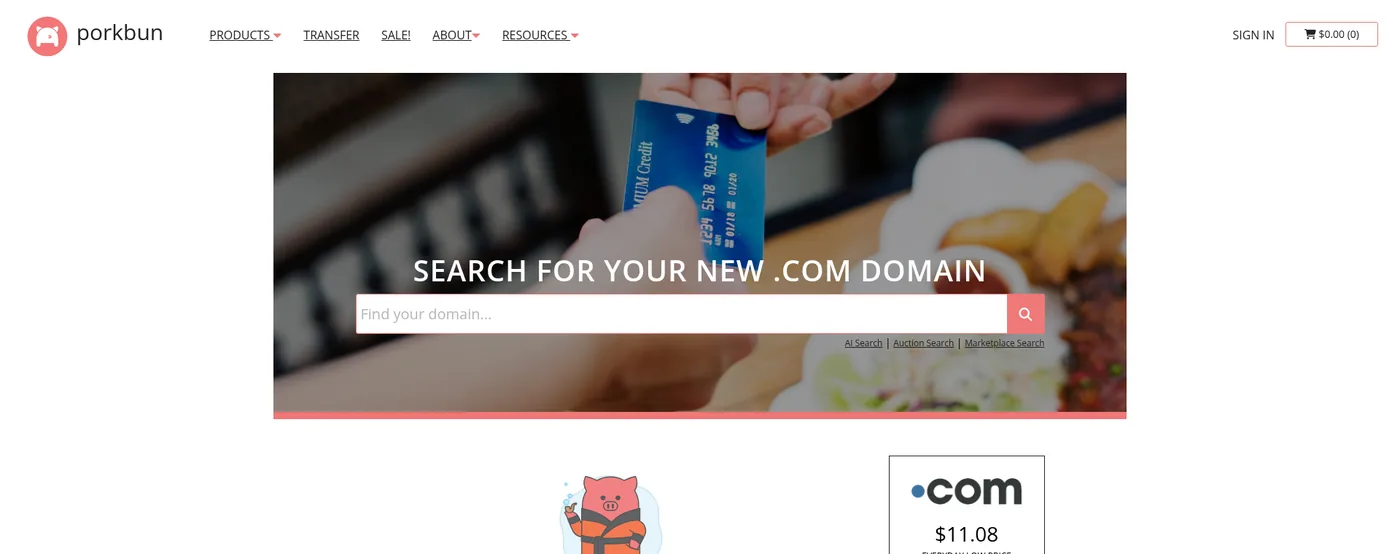
Porkbun public .com page, October 22, 2026; upper page crop. The cookie notice below the crop was excluded.
Porkbun's public .com page showed $11.08 on review. Its cost calculator displayed the same current price for year one and each renewal, with domain privacy included. Its API documentation describes price/availability lookup, registration, renewal, transfers, DNS records and account domain listing. The public search page permits up to 100 domains in one search. Those are procurement and management features; none is a mailbox or a sender reputation service.
Best for: an agency that wants clients to retain their own registrar account while operators automate repeatable DNS checks. Limitation: API access does not itself validate DKIM selectors or prevent an incorrect MX change. Keep a review step for every bulk edit. Porkbun's documentation also warns that .com registry costs can change, so today's equal first-year and renewal figures are not a future price guarantee.
Dynadot: best documented bulk portfolio tier
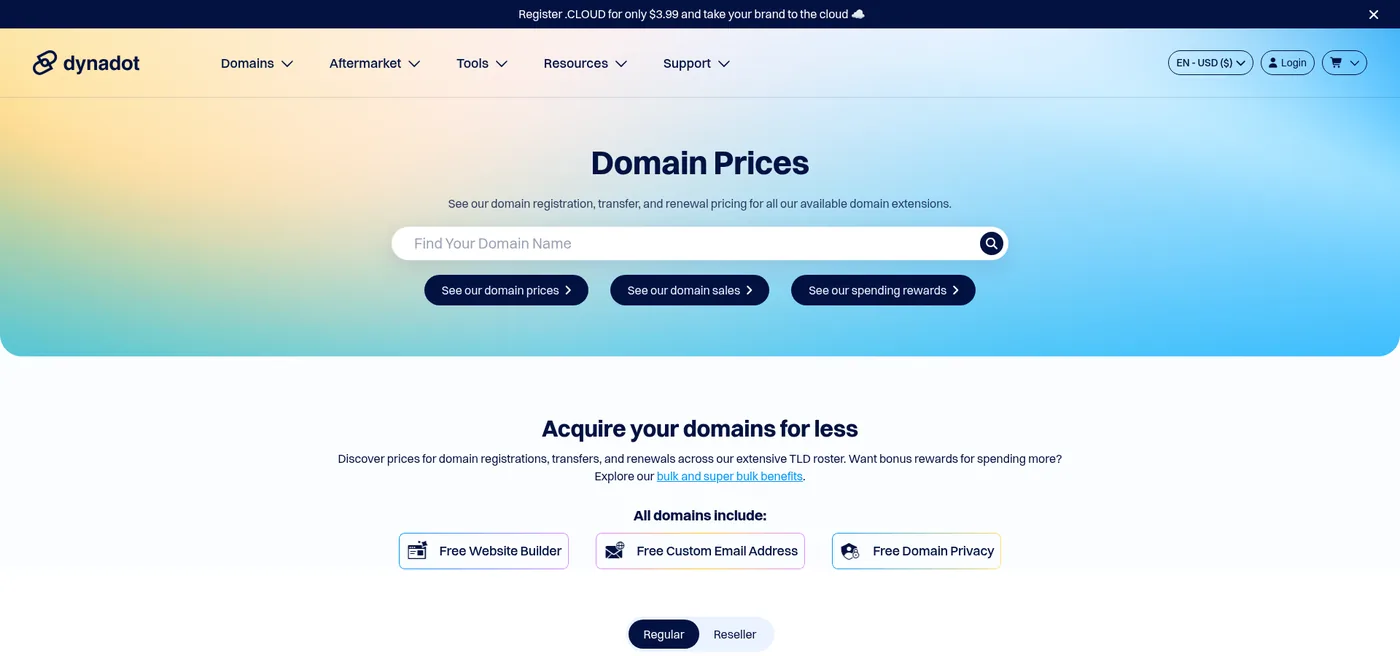
Dynadot public prices page, October 22, 2026; upper-page crop with the .com table visible.
Dynadot's price table lists $10.88 for .com registration, renewal and transfer at its regular tier, including privacy. The same page sets Bulk at $500 in account spending/prepay and Superbulk at $5,000, with higher daily bulk-search allowances. Those thresholds are not a reason to prepay before estimating actual use. An agency managing 20 domains at $10.88 each would spend about $218 for a year, below the Bulk threshold.
Best for: a portfolio operator who will use centralized search, renewals and account controls. Limitation: tier benefits and marketplace features can distract from the main job: preserving client ownership, accurate DNS and timely renewals. Compare the ordinary price first and confirm which account legally controls each domain.
Cloudflare Registrar: low-markup purchase with a DNS commitment
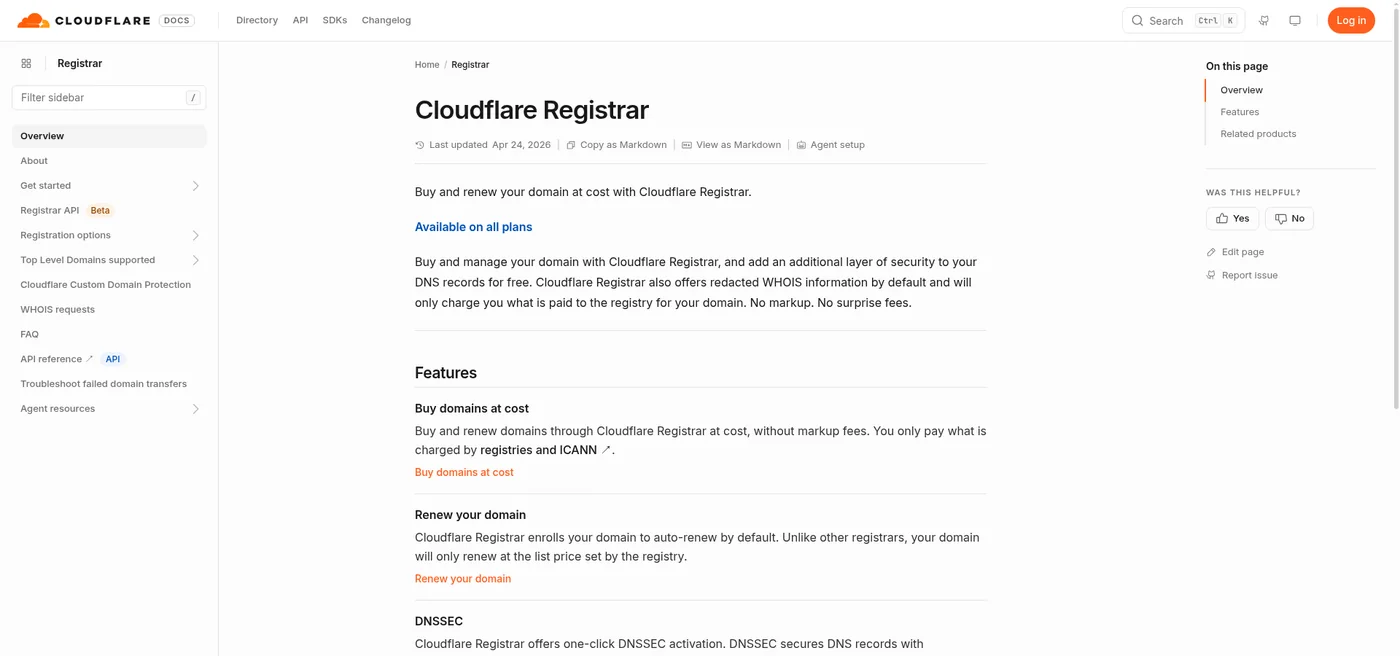
Cloudflare Registrar public documentation, October 22, 2026; upper-page crop showing its registration and renewal terms.
Cloudflare says it charges registry and ICANN cost without markup. Its registration documentation is equally clear about a decisive constraint: a domain bought there must use Cloudflare nameservers. You cannot switch to an unrelated DNS provider's authoritative nameservers while keeping the registration at Cloudflare. You can still publish MX, TXT, CNAME and other records for outside mail providers within Cloudflare DNS.
Best for: an operator already committed to Cloudflare DNS and willing to manage zones there. Limitation: if a client's IT team later requires a different authoritative DNS host, the domain must be transferred to another registrar. Model the handoff before choosing a low annual price. Cloudflare's own Registrar API can return registration and renewal costs for a specific name, which is a better checkout check than an approximate price in a roundup.
Namecheap: familiar bulk buying, expensive renewal to model
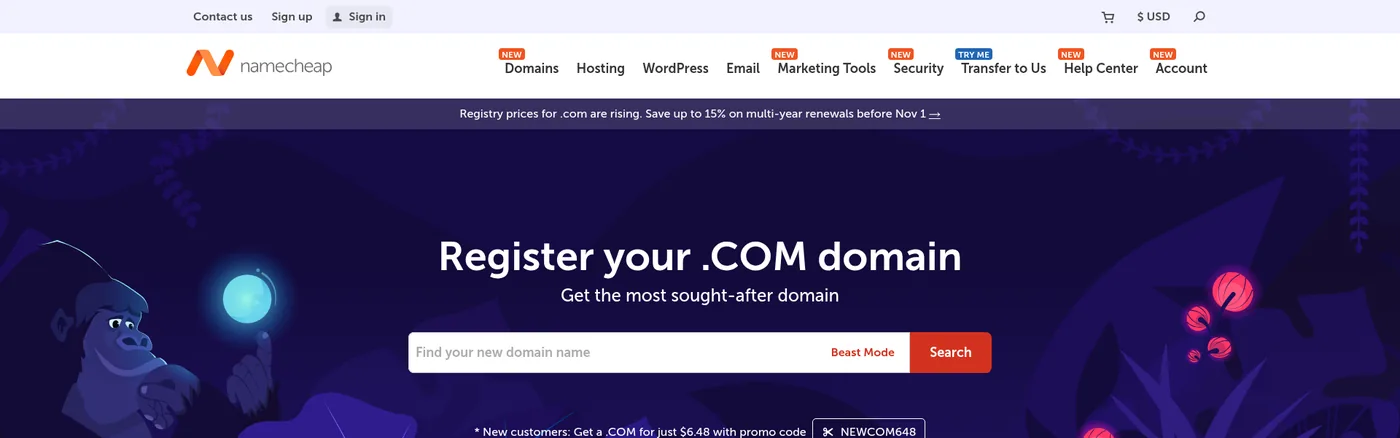
Namecheap public .com page, October 22, 2026; hero crop. Prices below come from the official USD price table, not the hero image.
Namecheap's current USD .com table showed a $11.28 sale registration and $18.48 renewal before ICANN fees on review. It includes basic DNS and domain privacy. Its one-domain new-customer code is not a realistic blended price for a 20-domain purchase. More consequentially, Namecheap has already announced higher regular .com prices effective November 1: $15.98 to register or transfer and $19.98 to renew or reactivate, before ICANN fees.
Best for: existing Namecheap teams whose account process and support familiarity outweigh the renewal premium. Limitation: portfolio cost is set by the recurring rate, not the promotional search result. Recheck the live price immediately before purchase and at every renewal planning cycle.
A 20-domain ownership and cost worksheet
Suppose an agency proposes 20 ordinary .com domains held for three years, with the client owning the registrar account and paying the registrar directly. This is an illustrative procurement calculation, not a sending-volume recommendation. The math uses the public prices seen October 22 and assumes no price changes, transfers, premium names, discounts, taxes or optional services:
| Option | Calculation at today's published rate | Three-year estimate for 20 domains | What to verify before buying |
|---|---|---|---|
| Porkbun | 20 × ($11.08 first year + 2 × $11.08 renewal) | $664.80 | Recheck actual checkout and renewal terms |
| Dynadot regular | 20 × ($10.88 first year + 2 × $10.88 renewal) | $652.80 | Bulk-tier eligibility and account ownership |
| Namecheap current table | 20 × ($11.28 first year + 2 × $18.48 renewal) | $964.80 before ICANN fees | November 1 announced increase makes this a stale-forward scenario |
| Cloudflare | 20 × (quoted first year + quoted renewals) | Quote each name/TLD | Cloudflare DNS commitment and transfer path |
The dollar spread is only one line in the budget. Mailbox licenses, DNS administration, software, client offboarding and mistakes can dominate it. Keep a register with domain, client legal owner, registrar login owner, authoritative nameservers, mail tenant, auto-renewal state, renewal date, billing card owner and transfer procedure. A missing owner or a lapse can interrupt MX resolution and replies regardless of which registrar won the price table.
Before you register a client sending domain
- Get the client's approval for the domain names, registration account, billing owner and exit procedure. Avoid names that impersonate another organization or mislead a recipient.
- Check the real renewal price and term for the exact TLD and domain. The cheapest first year is not the cheapest portfolio.
- Decide where authoritative DNS will live. A DNS record edited at a registrar panel does nothing if the nameservers point elsewhere.
- Document required MX, SPF, DKIM and DMARC records with the actual mailbox provider. Our authentication explainer and SPF lookup troubleshooting guide cover different technical problems; neither registrar creates a compliant campaign for you.
- Verify registrant contact, two-factor authentication, auto-renewal and a backup payment owner. Then test public DNS after every change.
If the real bottleneck is provisioning and managing sender accounts, return to the agency mailbox provider comparison. If the bottleneck is campaign sequencing, start with the cold-email software hub. Buying more domains before either process is clear only adds an inventory to maintain.