
For a B2B team of one to ten reps, the power-dialing options from CloudTalk, JustCall, Aircall and Allo all cost between $132 and $150 a month for three reps on annual billing, so seat minimums and fit decide the purchase, not the headline price. CloudTalk (Essential plus its Power Dialer add-on) is the cheapest published route for one to four reps. Allo's flat $50 team dialer makes it cheapest from five reps up and the cheapest fully priced month-to-month option at three. Aircall fits once three or more people also share a business phone system. Kixie suits teams that want to dial up to four lines from their CRM, and PhoneBurner is the dedicated single-line dialer for US and Canada teams willing to pay about three times more per rep. Already sequencing in Smartlead? Try SmartDialer first. If reps only call warm replies, click-to-call in your CRM or sequencer is probably enough.
A dialer only removes dead time between calls. It doesn't find phone numbers, write the opener or make a cold call compliant. Compliance and readiness checks follow the comparison.
Evidence and disclosure (checked October 16, 2026): We read each vendor's public pricing page, plus help or FAQ pages where needed, and captured each public website. We did not sign up, place calls or measure connect rates or call quality, so this is not a performance ranking. Prices are USD list prices before tax for US/Canada calling. OutboundXYZ has affiliate relationships with Instantly and Smartlead; that did not decide this ranking, and Smartlead's dialer is listed last because it only fits existing Smartlead users. We have no affiliate relationship with any other vendor named here.
Power dialers for small teams compared
| Tool | Best for | Verified price and billing basis | Seat minimum or key limit | Main drawback | Official source |
|---|---|---|---|---|---|
| CloudTalk | One to four reps who want power dialing now and parallel later | Essential $29 + Power Dialer add-on $15 per user/month, billed annually; Expert (dialer included) $49 annually or $69 monthly | Essential: 1 license; Expert: 3 licenses; Parallel Dialer add-on $39 per user/month, billed annually | Add-ons stack, and the monthly-billing rate for the dialer add-ons isn't shown | Pricing |
| JustCall | Two or more reps who want a full phone system with power dialing | Pro $49 per user/month annually, $69 monthly | 2-license minimum; parallel/predictive dialing only on quote-based SalesPro | The $29 Team plan has no power dialer | Pricing |
| Aircall | Three or more people who also need a shared business phone line | Professional $50 per license/month annually, $70 monthly | 3-license minimum on every plan; Essentials has no Power Dialer | One rep still pays for three licenses | Pricing |
| Allo | Teams of five to ten, or anyone who wants month-to-month billing | Business $32 per seat/month annually, $45 monthly, plus Power Dialer $50/month for the whole team | Business is positioned for teams "from 2 people up"; no contracts | Allo says its add-on pricing "is early and can still change" | Pricing |
| Kixie | CRM-led teams that want to dial up to four lines | No public price; 7-day free trial without a card | Multi-Line PowerDialer dials up to 4 lines; unlimited US/Canada minutes | You need a quote before you can compare cost | Plans |
| PhoneBurner | US/Canada teams that want a dedicated single-line dialer with a built-in CRM | Standard $140 per user/month annually, $165 monthly | Dials US and Canadian numbers only; no multi-line by design | About three times the per-rep cost of the phone-system options | Pricing, FAQ |
| Smartlead SmartDialer | Teams whose email sequences already run in Smartlead | Credit plans from $9/month on top of a Smartlead plan (Base is $39 monthly) | Billed per minute; recording and transcription cost more per minute; US numbers from $1/month | Usage cost depends on a rate card shown in the app; sequential dialing only | Pricing, help |
"Unlimited" minutes means US and Canada calling under each vendor's fair-use terms. International calls, toll-free destinations and extra numbers are usually billed separately.
Power, parallel or predictive: what changes for the rep
- Power (sequential) dialing calls the next contact when the last call ends, so the rep sees each record before the ring. Every numbered tool below offers this mode.
- Parallel dialing rings several numbers at once and connects the rep to whoever answers first; the other lines are released. CloudTalk's add-on dials up to 10 numbers, Kixie up to 4, Allo's separate parallel dialer 3 to 5, and JustCall SalesPro lists a predictive dialer with up to 10 lines.
- Predictive dialing paces dials to when the software expects a rep to be free, a contact-center pattern rarely suited to a team of five.
Parallel dialing trades preparation for volume. The rep has less time to see who picked up, and an answered call with no free rep can be abandoned, which is regulated (see compliance below); PhoneBurner's FAQ cites this as its reason for refusing multi-line dialing. Our judgment for a team under ten: start with single-line power dialing and add parallel lines only when your lists are large enough that speed matters more than a researched opener. A three-rep team working a 400-account target list doesn't obviously win by exhausting it three times faster.
How we narrowed the list
We started from the tools named in current search results and buyer threads and kept products that sell power dialing to teams under ten, publish a price or clearly say they're quote-only, sync calls to HubSpot, Salesforce or Pipedrive, and state their calling terms. Most pages ranking for "best power dialer" are written by dialer vendors and several quote outdated prices, so every figure here comes from the vendor's own page on October 16.
Orum (9-seat minimum) and Nooks (quote-only, aimed at SDR floors) appear in the parallel-dialer section instead. Dialpad was left out because we couldn't confirm from its public pricing page which plan includes list dialing. For the wider stack around a dialer, see the SDR tech stack and the sales development tools guide.
The seven options by use case
1. CloudTalk — best entry point for one to four reps
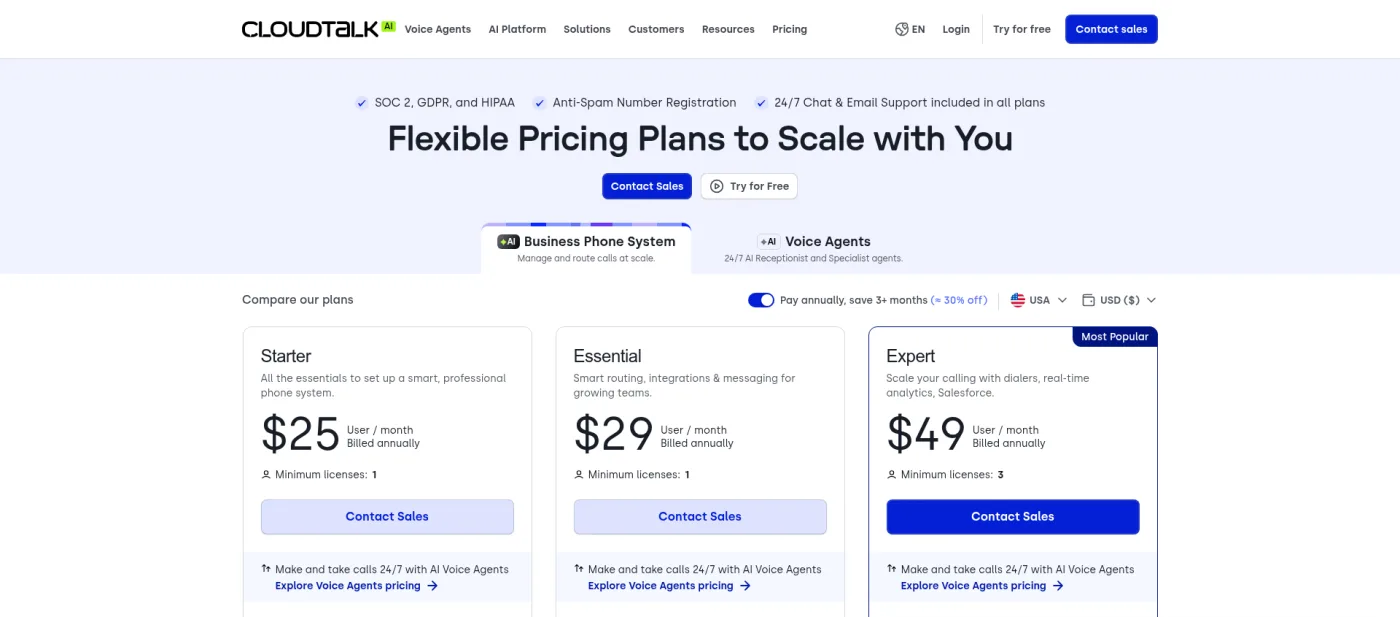
CloudTalk public pricing page (US view), captured October 16, 2026; cropped above a cookie banner.
CloudTalk's pricing page combines a plan with add-ons. In the US view, Essential costs $29 per user per month billed annually ($39 monthly) with a one-license minimum, and the Power Dialer add-on is $15 per user per month billed annually. That puts a single rep on power dialing for about $44 a month. Expert ($49 annually, $69 monthly) includes the preview and power dialer but requires three licenses. The Parallel Dialer add-on is $39 per user per month billed annually and dials up to 10 numbers with answering-machine detection.
Essential is the first tier with standard CRM integrations (CloudTalk names HubSpot, Pipedrive and Salesforce), though the Expert card is the one that mentions Salesforce, so confirm your CRM's tier. Anti-spam number protection and branded caller ID are add-ons.
Best for: a founder or small team that wants to start cheaply and keep a parallel option. Drawback: the price you see is assembled from pieces, and the page didn't show what the dialer add-ons cost on monthly billing.
2. JustCall — best for two or more reps on a full phone system
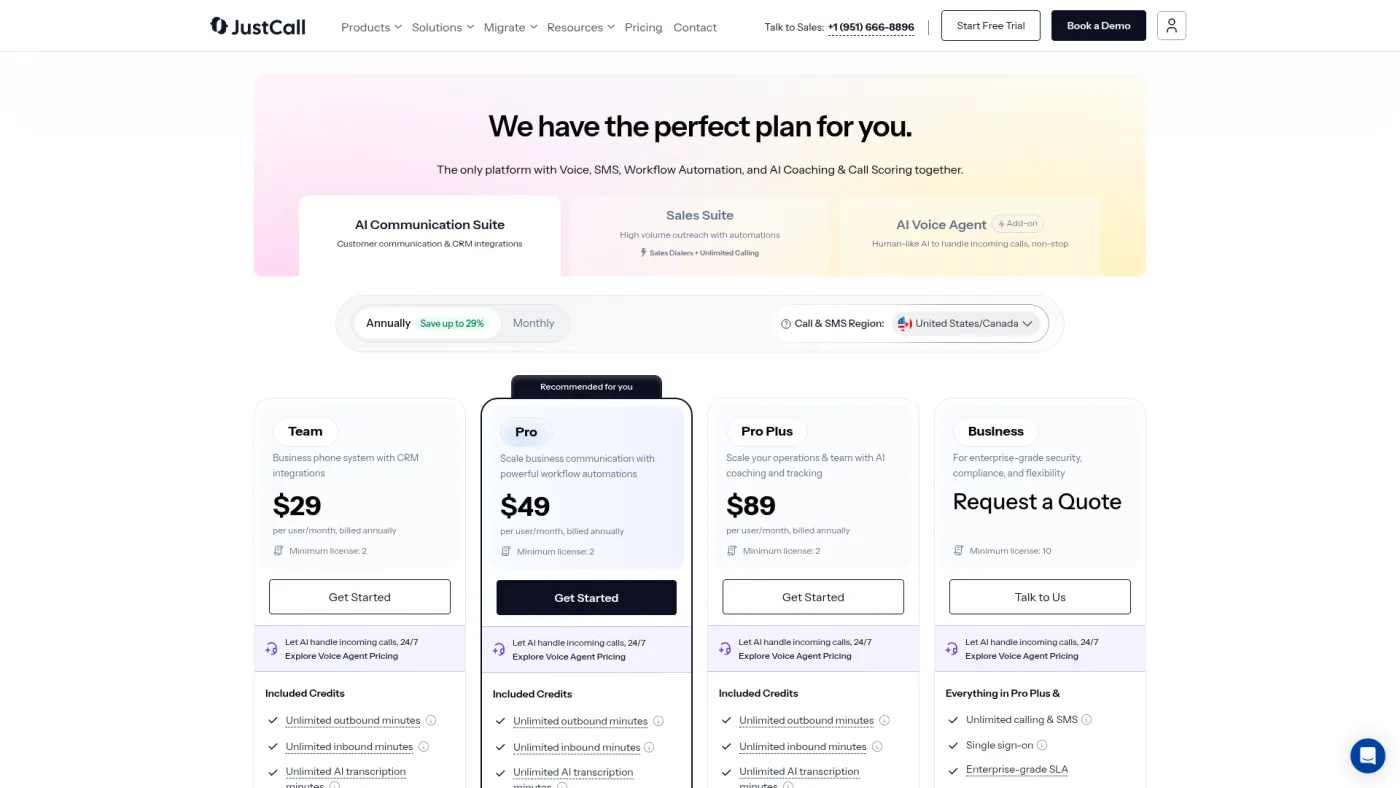
JustCall public pricing page (United States/Canada region), captured October 16, 2026.
JustCall's pricing puts the power dialer on Pro: $49 per user per month billed annually, $69 monthly, with a two-license minimum. The $29 Team plan has CRM integrations but no power dialer. Pro adds bulk SMS, call routing and a Salesforce CTI integration; both plans list unlimited US/Canada outbound minutes under a fair-usage policy. Each account gets two numbers, and the free trial runs 14 days.
Multi-line dialing sits in a separate, quote-only SalesPro plan that lists a predictive dialer with up to 10 lines and Number Health.
Best for: a team that needs a business phone system with SMS and wants power dialing in the same seat. Drawback: the dialer starts one tier above the advertised entry price, and parallel dialing means a sales conversation.
3. Aircall — best when three or more people share the phone system
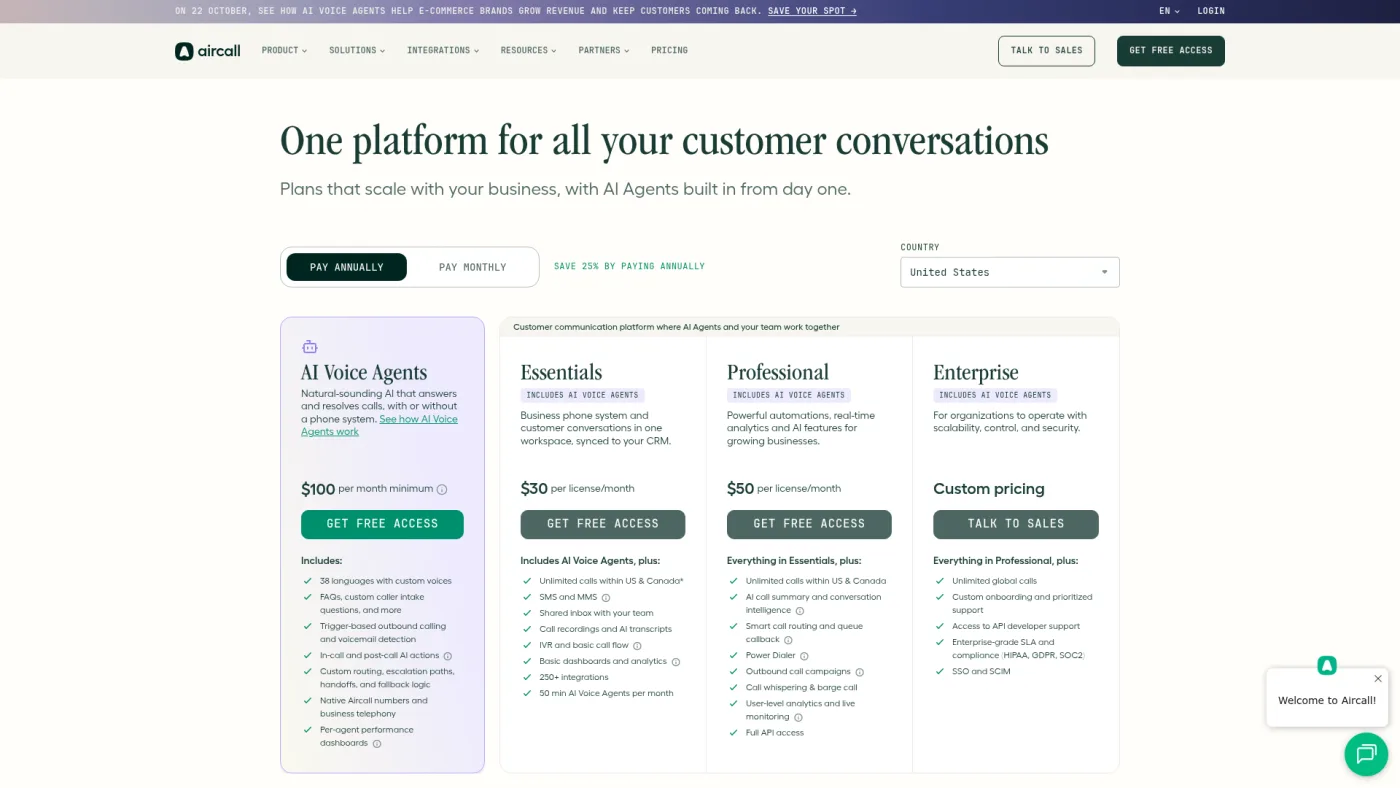
Aircall public pricing page (United States, annual billing), captured October 16, 2026.
Aircall's Professional plan includes the Power Dialer, voicemail drop and outbound call campaigns for $50 per license per month annually or $70 monthly in the US view. The FAQ states that all plans require a minimum of three licenses regardless of billing cycle. Each plan includes one local or toll-free number; extra numbers are $6 a month. Aircall lists HubSpot, Salesforce and Pipedrive integrations, plus paid add-ons that matter for outbound: a Number Reputation Dashboard at $0.03 per check and branded caller ID at $0.08 per call.
Best for: a small company where sales, support and the founder share one phone system. Drawback: a solo rep pays at least $150 a month for three Professional licenses, and the public plans list a Power Dialer but no parallel dialing mode.
4. Allo — best flat-fee dialer for month-to-month and growing teams
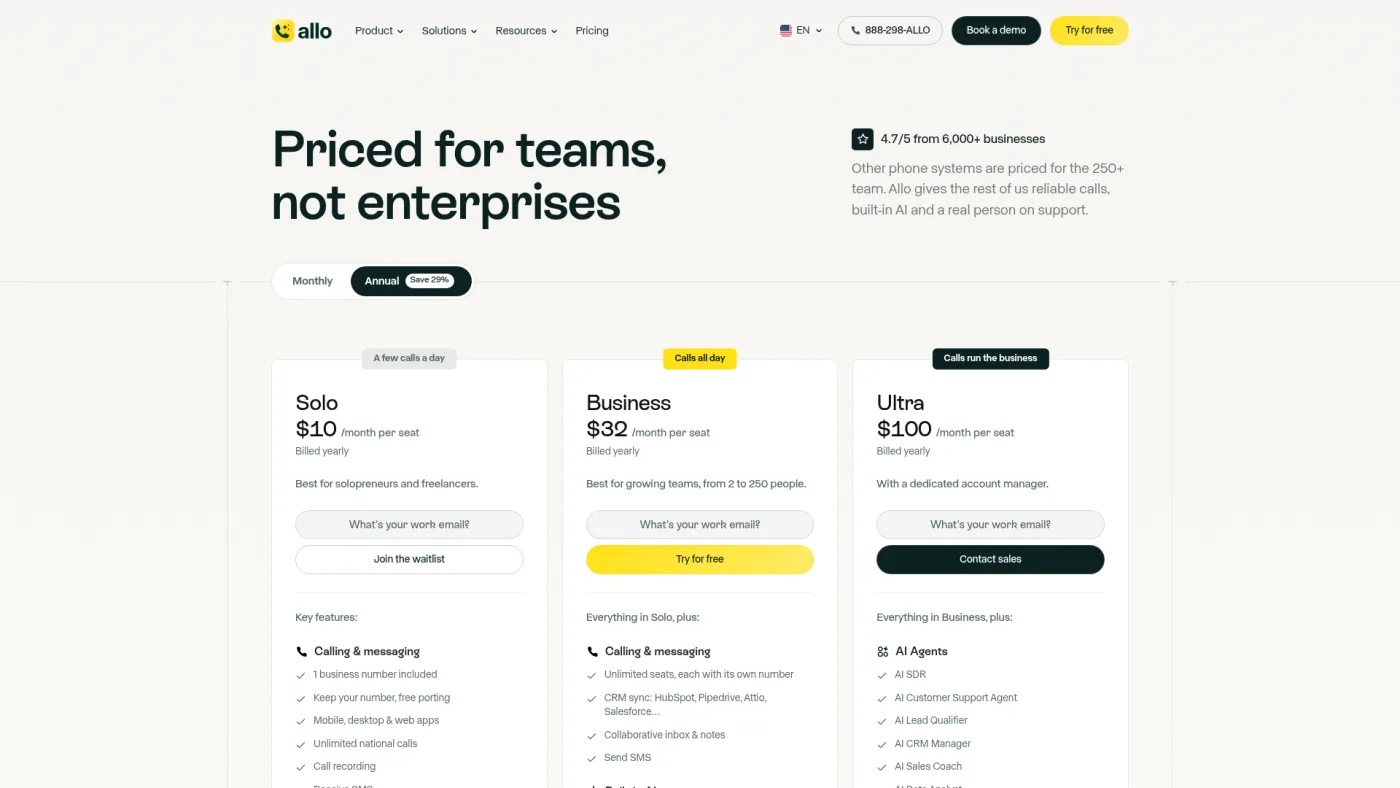
Allo public pricing page (annual billing), captured October 16, 2026; the Power Dialer add-on is priced further down the page.
Allo's pricing FAQ lists Business at $32 per seat per month billed yearly or $45 monthly, and the Power Dialer as a flat $50 a month for the whole team. Because the dialer costs the same for three people as for ten, Allo becomes the cheapest published option from five reps on annual billing, and at three reps it's the cheapest fully priced month-to-month option ($185). Business includes CRM sync with HubSpot, Pipedrive, Attio and Salesforce and unlimited national calls; there are no contracts, seat changes are prorated, and extra numbers start at $5 a month.
A separate parallel dialer rings three to five contacts at once, but the pricing page lists no price for it.
Best for: small teams that want a modern phone system and a dialer without per-seat dialer fees. Drawback: the one-seat Solo plan was waitlisted and has no dialer, Business is positioned "from 2 people up," and Allo calls its add-on pricing early and subject to change.
5. Kixie — best for CRM-driven multi-line dialing
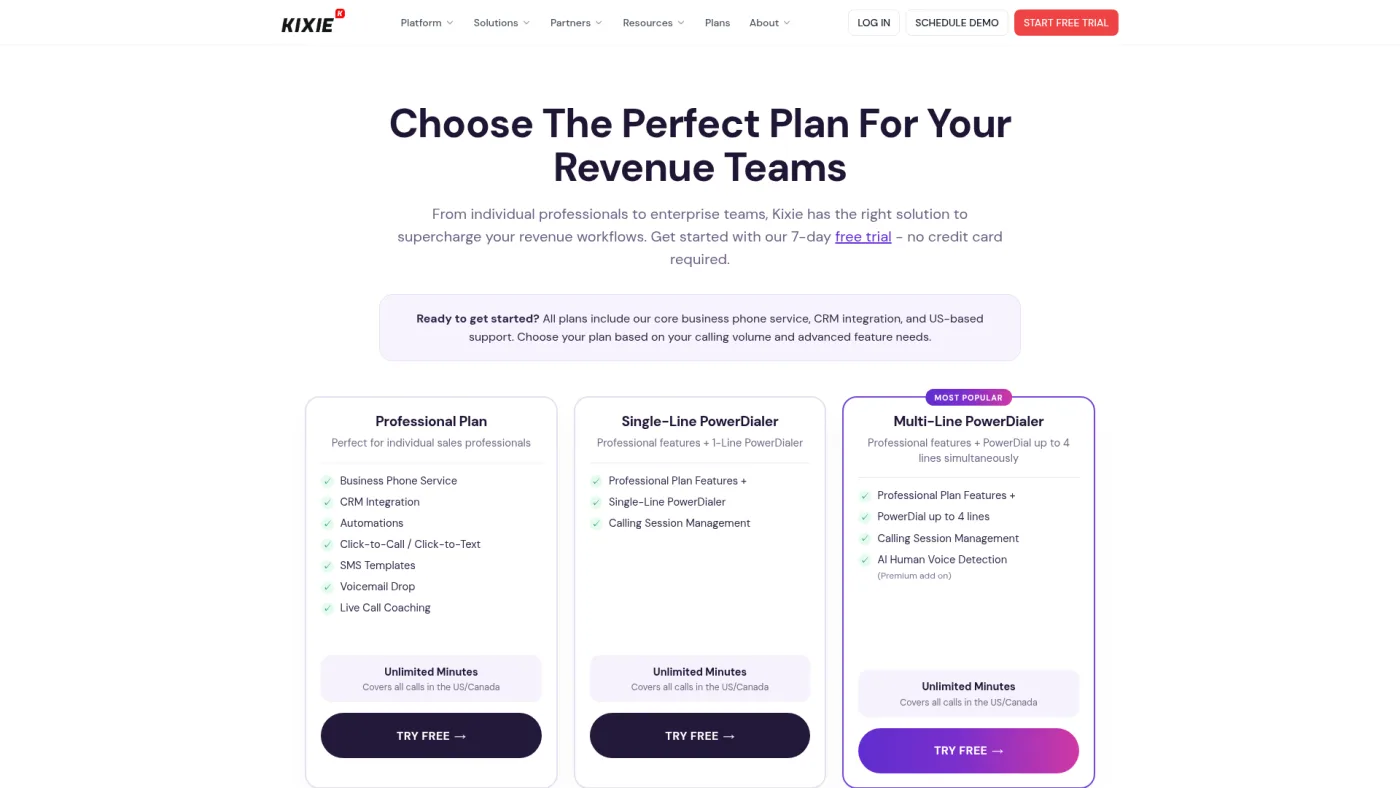
Kixie public plans page, captured October 16, 2026.
Kixie's plans page has three tiers: Professional, Single-Line PowerDialer and Multi-Line PowerDialer, which dials up to four lines at once. Every plan includes business phone service, CRM integration and unlimited US/Canada minutes; Kixie lists HubSpot, Salesforce, Zoho and Pipedrive integrations. Add-ons include ConnectionBoost for connect rates, Conversation Intelligence and DNC registry compliance. AI human-voice detection is a premium add-on on the multi-line plan.
Kixie shows no prices, so it's absent from our cost model. Use the 7-day trial and ask for a written quote at your seat count.
Best for: teams that live in their CRM and want a middle step between single-line and full parallel dialing. Drawback: without public pricing, comparison takes a sales call.
6. PhoneBurner — best dedicated single-line dialer for US and Canada
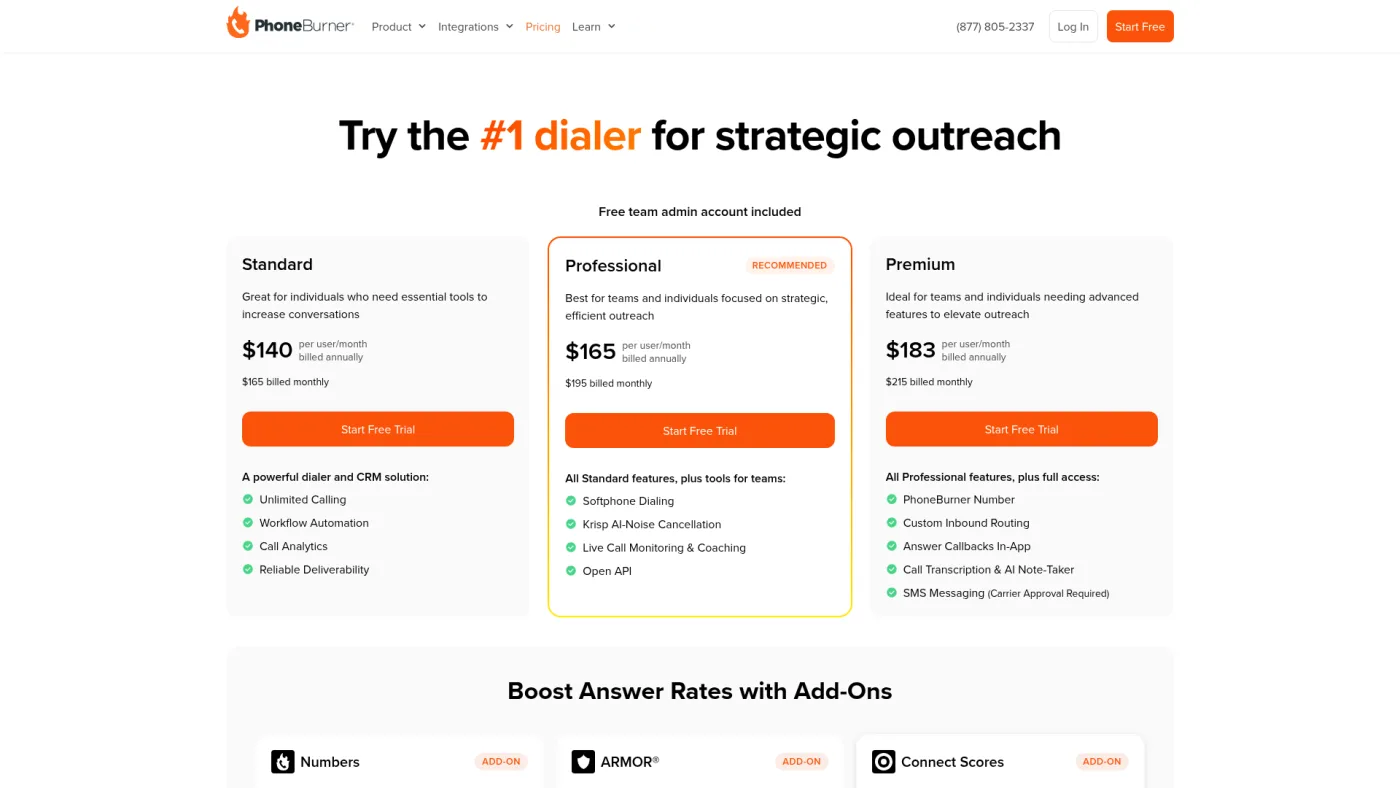
PhoneBurner public pricing page, captured October 16, 2026.
PhoneBurner's pricing starts at Standard: $140 per user per month billed annually or $165 monthly, with unlimited power dialing, a built-in CRM and a free team admin account. Its FAQ is unusually direct: it only dials US and Canadian numbers, it's not a predictive or multi-line dialer, it won't dial after 9 p.m. local time (based on area code), and it integrates with DNC.com for registry scrubbing. Direct integrations include Salesforce, HubSpot and Zoho; Pipedrive goes through a third party.
Check how your reps will connect. The pricing page lists softphone (browser) dialing as a Professional feature at $165 annually, and number monitoring and spam-flag remediation (ARMOR) as an add-on without a public price.
Best for: US-focused teams that want the dialer to be the whole workflow. Drawback: about three times the per-rep price of the phone-system options, and no international dialing.
7. Smartlead SmartDialer — best if your sequences already live in Smartlead
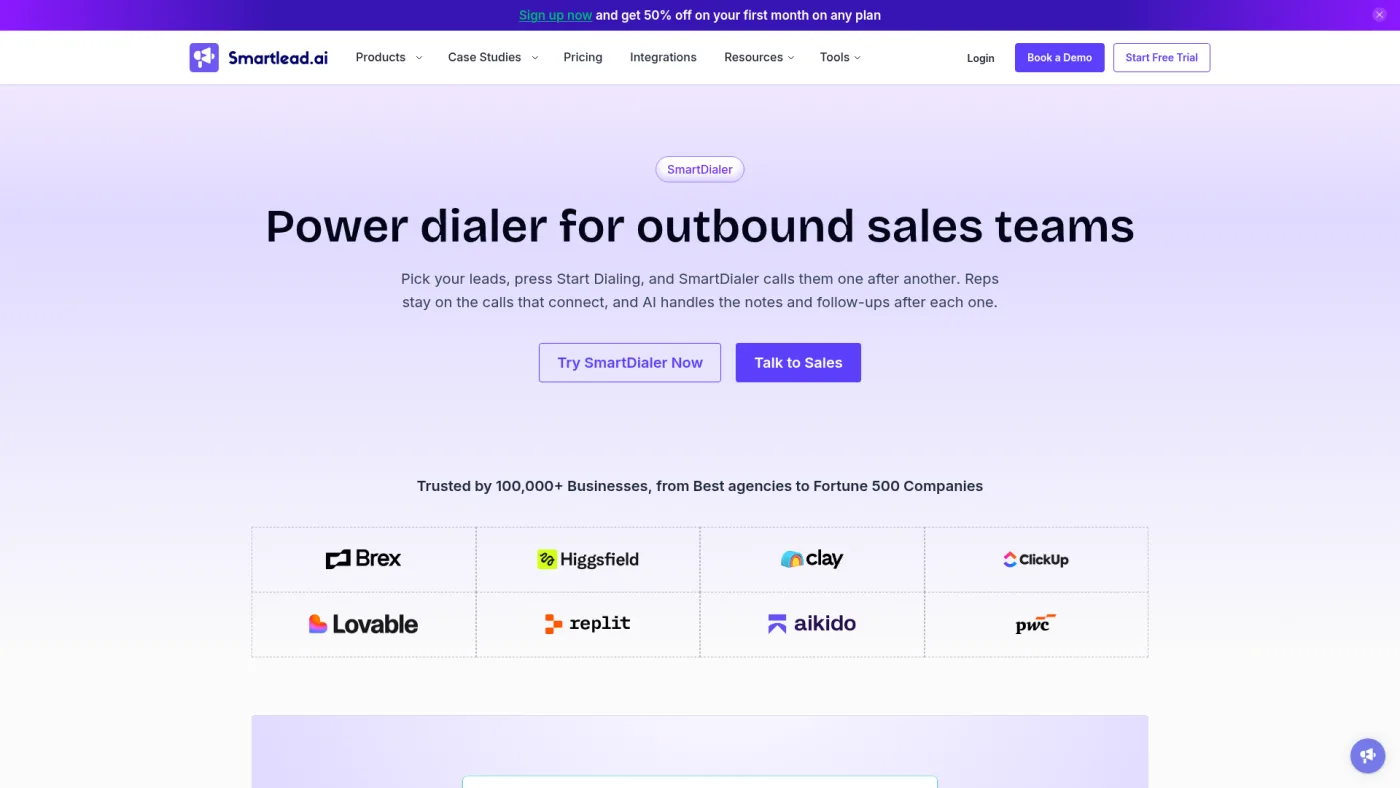
Smartlead SmartDialer public product page, captured October 16, 2026.
SmartDialer puts calling inside Smartlead: a call can be a step in a campaign sequence, and the auto-dial guide describes selecting leads in Call in Queue and pressing Start Dialing to call them one after another. Smartlead's help center says plans run from $9 to $699 a month, calls are billed per minute, recording and transcription cost more per minute, and US local and toll-free numbers start at $1 per number per month. Recording is on by default with a reminder to follow local recording laws. Call activity syncs to HubSpot.
Heavy callers should read the in-app rate card before comparing that with a flat seat. For the email side, see our Smartlead review.
Best for: small teams already running Smartlead who want calls and emails in one queue. Drawback: sequential dialing only, and the per-minute rate isn't on the public pricing page.
Dedicated parallel dialers: Nooks and Orum
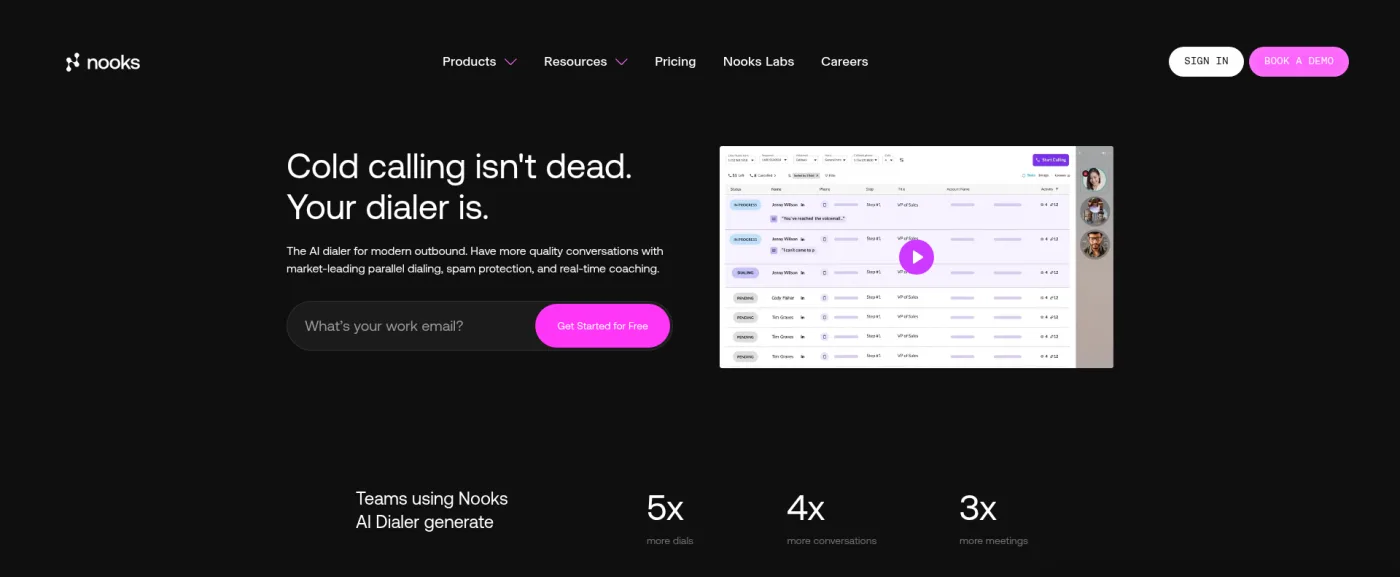
Nooks AI Dialer public page, captured October 16, 2026; cropped above a chat widget.
Nooks describes parallel and power dialing, spam protection with number rotation and reputation monitoring, a virtual salesfloor, and HubSpot and Salesforce sync. Its pricing page offers only a custom quote.

Orum public pricing page, captured October 16, 2026.
Orum lists power and parallel dialing and up to 10 caller IDs per month, with a 9-seat minimum and prices on request. For a team of three, that minimum is the whole answer.
What three reps actually pay
Assumptions: three reps calling US and Canadian numbers, one CRM already in place, single-line power dialing, list prices before tax. Excluded: extra numbers, number-reputation or branded caller ID add-ons, international minutes, SMS registration and the CRM itself. The one-rep column applies each vendor's seat minimum.
| Option | 3 reps, annual billing | Per year | 3 reps, monthly billing | 1 rep, annual billing |
|---|---|---|---|---|
| CloudTalk Essential + Power Dialer add-on | $132/month | $1,584 | $117 + add-on at its monthly rate | $44 |
| CloudTalk Expert | $147/month | $1,764 | $207 | $147 (3-license minimum) |
| JustCall Pro | $147/month | $1,764 | $207 | $98 (2-license minimum) |
| Aircall Professional | $150/month | $1,800 | $210 | $150 (3-license minimum) |
| Allo Business + Power Dialer | $146/month | $1,752 | $185 | $82 if one Business seat is accepted; $114 at two |
| PhoneBurner Standard | $420/month | $5,040 | $495 | $140 |
| Smartlead + SmartDialer | Smartlead plan + credits from $9 + per-minute usage | Depends on usage | Same, with Base at $39 | Smartlead plan + credits from $9 |
| Kixie | Quote | Quote | Quote | Quote |
Three things fall out of the table. At three reps, the CloudTalk, JustCall, Aircall and Allo options sit within $18 a month of each other, so pick on features and minimums; CloudTalk's add-on route stays cheapest up to four reps, and from five Allo's flat dialer fee wins ($210 against $220 a month). Seat minimums matter most at one or two reps: Aircall's three-license floor makes a single rep cost more than three times as much as on CloudTalk. And PhoneBurner's premium is a workflow choice, a dedicated dialer with its own CRM, not a price-per-feature bargain.
Then add what the table leaves out: reputation tools priced per check, call or number, and annual terms that may not let you drop seats before renewal.
Compliance basics to check before the first call block
These are questions to settle with counsel, not legal advice. Rules depend on who you call, from where, and how.
- "B2B" is not a blanket exemption. The FTC's Telemarketing Sales Rule guide says most business-to-business calls are exempt, but the FTC's 2024 amendment extended its misrepresentation protections to businesses.
- Mobile numbers and recorded voices. FCC rules (47 CFR 64.1200) require prior express consent for calls to cell numbers made with an autodialer or an artificial or prerecorded voice, with limited exceptions. Prerecorded voicemail drops and AI-generated voices fall into that voice category. Whether your dialer counts as an autodialer is a legal question.
- Do-not-call and calling hours. The FCC's registry and 8 a.m. to 9 p.m. rules are written for residential subscribers, and B2B lists often contain personal mobiles. Keep an internal do-not-call list and ask how the vendor scrubs numbers (Kixie sells a DNC add-on; PhoneBurner integrates with DNC.com).
- Abandoned calls. The same FCC rule caps abandoned telemarketing calls at 3% of live-answered calls per 30-day campaign and counts a call as abandoned if no rep connects within two seconds of the greeting. Ask any parallel or predictive vendor how it handles that.
- Recording consent. California's Penal Code 632 requires the consent of all parties to record a confidential communication; other places differ. Configure a disclosure before you turn recording on.
- Outside the US. In the UK, business numbers can be registered with the Corporate TPS, and the ICO's B2B marketing guidance expects you to screen them.
Questions to ask in every dialer demo
- Which plan includes the dialer, what's the seat minimum, and can we remove seats before an annual renewal?
- What do "unlimited" minutes exclude: international, toll-free, fair-use caps?
- How are our numbers registered and monitored for spam labels, and what does that cost per number, check or call?
- What syncs to our CRM, in which direction: calls, recordings, dispositions, tasks?
- How many lines does parallel mode dial, and what happens when two people answer?
- Where are recording, consent and do-not-call settings, and who can change them?
When a dialer isn't worth it yet
A dialer pays off when reps have a list with good phone numbers and hours blocked for calling. If calling is mainly a follow-up to positive email replies, one-off calling is enough: Instantly's CRM lets you call from an opportunity after buying a number and credit, and Apollo bundles a dialer with its data and sequencing (see our Apollo review). If you have no CRM yet, Close puts a power dialer on its Growth plan ($99 per user per month annually, $109 monthly) with calling usage billed at cost. Our Instantly review covers the email side if that's your main channel.
The other prerequisite is an opener worth hearing. In a May 2023 video, Jan contrasted the channels: an email prospect can check your website and profile before deciding to reply, while a cold call runs on the script in the moment. Our inference for dialer buyers, not his statement about dialers: a dialer multiplies those in-the-moment conversations, so fix the list and the opener before buying speed. The SMB outbound stack shows where calling fits next to email and data.
Frequently asked questions
What is the difference between a power dialer and a parallel dialer?
A power dialer calls one contact at a time and starts the next call when the previous one ends. A parallel dialer rings several numbers at once and connects the rep to whoever answers first. Vendors claim more live conversations per hour from parallel dialing, but reps get less time to prepare and abandoned calls become a risk.
How much does a power dialer cost per user?
On October 16, 2026, CloudTalk Essential plus its Power Dialer add-on cost $44 per rep per month on annual billing, the cheapest published route for up to four reps. JustCall Pro ($49) and Aircall Professional ($50) cost about the same but carry two- and three-license minimums. Allo charges $32 per seat plus a flat $50 for the team's dialer, which is cheaper per rep from five reps up. PhoneBurner starts at $140 per user.
Is power dialing legal for B2B cold calling?
It depends on the numbers you call and how. Calls to mobile numbers using an autodialer or a prerecorded or AI voice can require prior consent under FCC rules, recording laws vary by state and country, and the FTC's 2024 amendment applies its misrepresentation rules to B2B calls. Get legal advice for your setup.
Do power dialers work with HubSpot, Salesforce and Pipedrive?
Most do, at different tiers. CloudTalk, JustCall, Aircall, Kixie and Allo list all three; JustCall puts its Salesforce CTI integration on Pro. PhoneBurner integrates directly with Salesforce and HubSpot and reaches Pipedrive through a third party. SmartDialer syncs call activity to HubSpot.
Do I need a separate dialer if I already use Instantly or Smartlead?
Not necessarily. Smartlead's SmartDialer adds sequential auto-dialing with per-minute billing. Instantly's CRM supports one-off calls from an opportunity, which suits warm replies but isn't a list dialer. For daily call blocks, a dedicated dialer with seat pricing is easier to budget.