The best sales development tool depends on how much of the job you intend to delegate. AiSDR is the most accessible starting point for a team comparing a packaged autonomous agent. Salesforge's Agent Frank is the clearest email-first agent with public usage economics. Reply's Jason AI is the best bridge when you want AI inside a mature multichannel sequencing platform.
Amplemarket, Artisan and 11x belong in more sales-led evaluations. They can own more workflow, but the buyer needs a clearer operating model, contract and human escalation path before “autonomy” becomes useful.
Quick verdict: do not buy an AI SDR to repair bad targeting, missing suppression rules or an ownerless CRM. First decide who owns research, approval, sending, replies, qualification, booking and failure recovery. Then buy the smallest delegation boundary that removes a real bottleneck.
Prices, plan limits and screenshots were checked on public vendor websites on September 3, 2026. We did not run the six products against the same private campaign, so this is not a performance leaderboard. Vendor claims about meetings, replies, pipeline and replacement of human work remain vendor claims.
Sales development tools and AI SDRs compared
| Tool | Best for | Public pricing signal | Delegation boundary | Main drawback |
|---|---|---|---|---|
| AiSDR | Small teams evaluating a packaged AI outbound agent | Solo $250/month; Explore $900; Scale $2,500 | Research, outreach and follow-up with integrations | Explore and Scale use quarterly commitments; no free trial was shown |
| Salesforge Agent Frank | Email-first autonomous outbound with visible contact economics | $499/month billed quarterly; $417 annual equivalent | Prospecting and email outreach around 2,000+ contacts/month | Contact allowance is not the same as qualified-pipeline capacity |
| Reply Jason AI | Teams wanting AI inside a sequencer and multichannel stack | Jason starts at $500/month | Prospect research, outreach and replies alongside Reply workflows | AI and standard seat/campaign costs need a scenario quote |
| Amplemarket Duo | Governed data, sequencing and AI assistance in one platform | Startup $600/month on an annual term for two users; larger plans custom | AI-assisted research and execution within a sales platform | Annual starting commitment and suite scope can be heavy for an unproven motion |
| Artisan Ava | Sales-led autonomous outbound program | Custom quote | Lead research, messaging and outbound execution | No public universal starting price; evaluation depends on a written scope |
| 11x Alice | Higher-budget managed autonomous prospecting | Growth shown at $3,750/month billed annually | Prospecting and engagement against a stated monthly prospect allowance | High annual commitment raises the cost of learning the operating model |
These are not interchangeable products. “AI SDR” can mean a writing assistant, an agent working inside a sequencer, or a managed system that attempts to own most of prospecting. The order favors a clear buying and operating path, not the loudest automation promise.
How we selected the shortlist
We refreshed this existing sales-development-tools URL instead of creating a competing best-ai-sdr-tools article. The canonical page already had search visibility for sales-development intent, and its former body discussed the broader stack without giving buyers a current AI-SDR comparison.
Every included vendor had to provide enough public evidence to explain its category, commercial starting point or quote requirement, and intended workflow. We then compared:
- Autonomy boundary: exactly which work the system can research, draft, send, classify, route or book.
- Human controls: approval, suppression, pause, exception and handoff paths.
- State ownership: where the authoritative lead, campaign, reply and CRM state lives.
- Failure recovery: retries, observability, duplicate prevention and what happens after a partial success.
- Commercial model: seats, leads, contacts, mailboxes, credits, commitments and managed-service scope.
- Evidence quality: current public vendor material, with unknown terms left unknown.
We captured a real public 1920×1080 website screenshot for every vendor and saved it locally as an optimized 1400×788 WebP without cropping. We did not create product mockups or use private-account data. No existing OutboundXYZ review score or affiliate destination was changed.
What an AI SDR actually is
An AI SDR should be classified by the actions it can take and the consequences of getting them wrong.
| Category | Typical actions | Appropriate starting control |
|---|---|---|
| Copilot | Research, summarize, draft | Human approves every external action |
| Sequencer with AI | Draft, personalize, classify within campaign rules | Human owns audience, campaign, suppression and reply exceptions |
| Autonomous outbound agent | Source, research, message, follow up, route or book | Named owner, restricted permissions, audit trail, pause control and staged rollout |
| Managed AI-SDR service | Vendor operates agent plus process | Written scope, data ownership, escalation SLA, QA sample and exit/export plan |
Do not accept “books meetings” as a technical specification. Ask which source creates the lead, when verification occurs, how opt-outs propagate, what the system does with ambiguous replies, and which successful response marks a record complete.
The six best sales development and AI SDR tools
1. AiSDR — best accessible autonomous-agent starting point
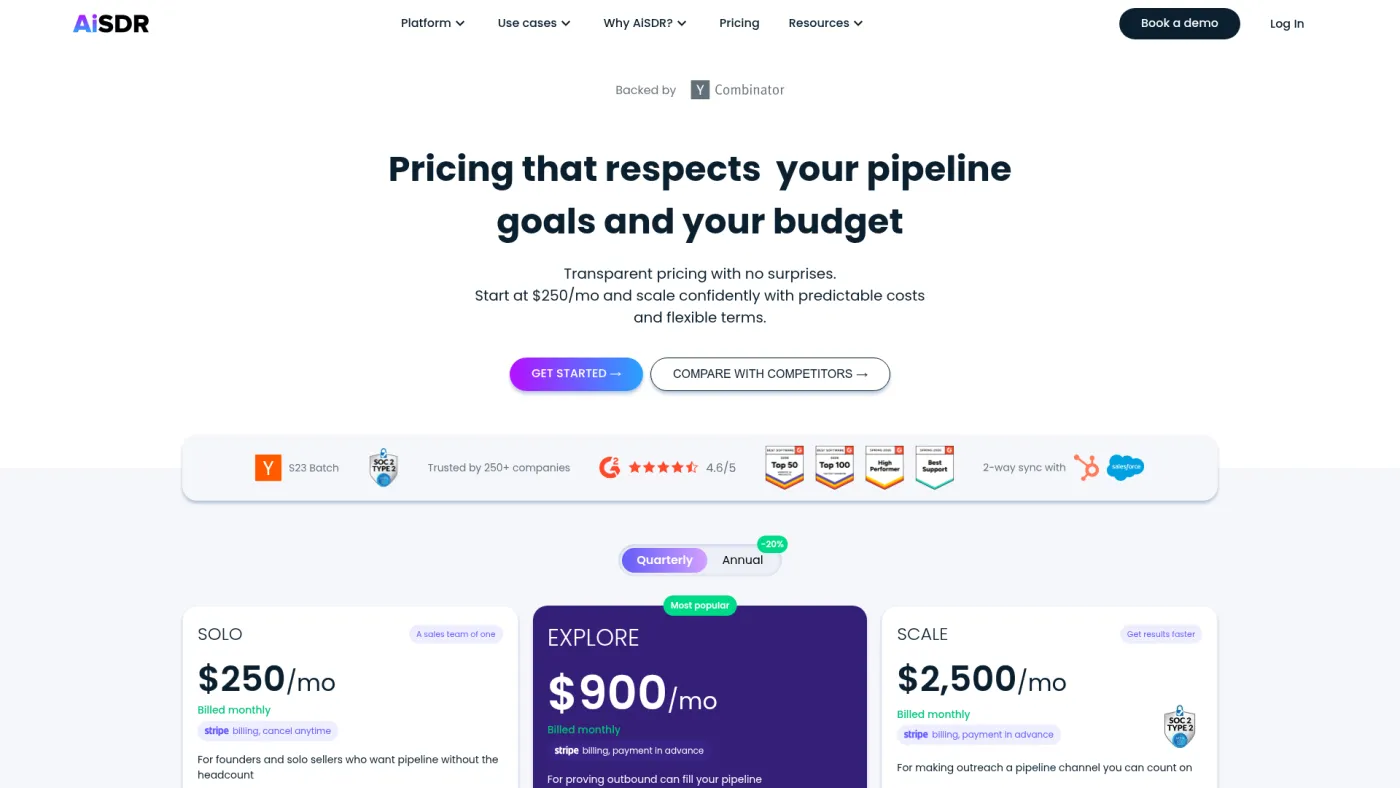
AiSDR presents a direct autonomous-sales-agent proposition with public plan anchors. That makes it easier than custom-only vendors to decide whether a controlled trial is commercially realistic.
AiSDR's official pricing page showed Solo at $250/month, Explore at $900/month and Scale at $2,500/month. The vendor noted quarterly billing for Explore and Scale and did not advertise a free trial on the page reviewed. Plan scope changes with integrations, lead volume and managed services, so confirm the exact contract and data source.
Best for: a small team that has a defined outbound process and wants to test a packaged autonomous workflow without starting at an enterprise contract.
Drawback: entry price does not establish pipeline economics. Qualification rules, human review, mailboxes, lead sourcing, reply ownership and the quarterly commitment all affect the real test cost.
2. Salesforge Agent Frank — best transparent email-first agent
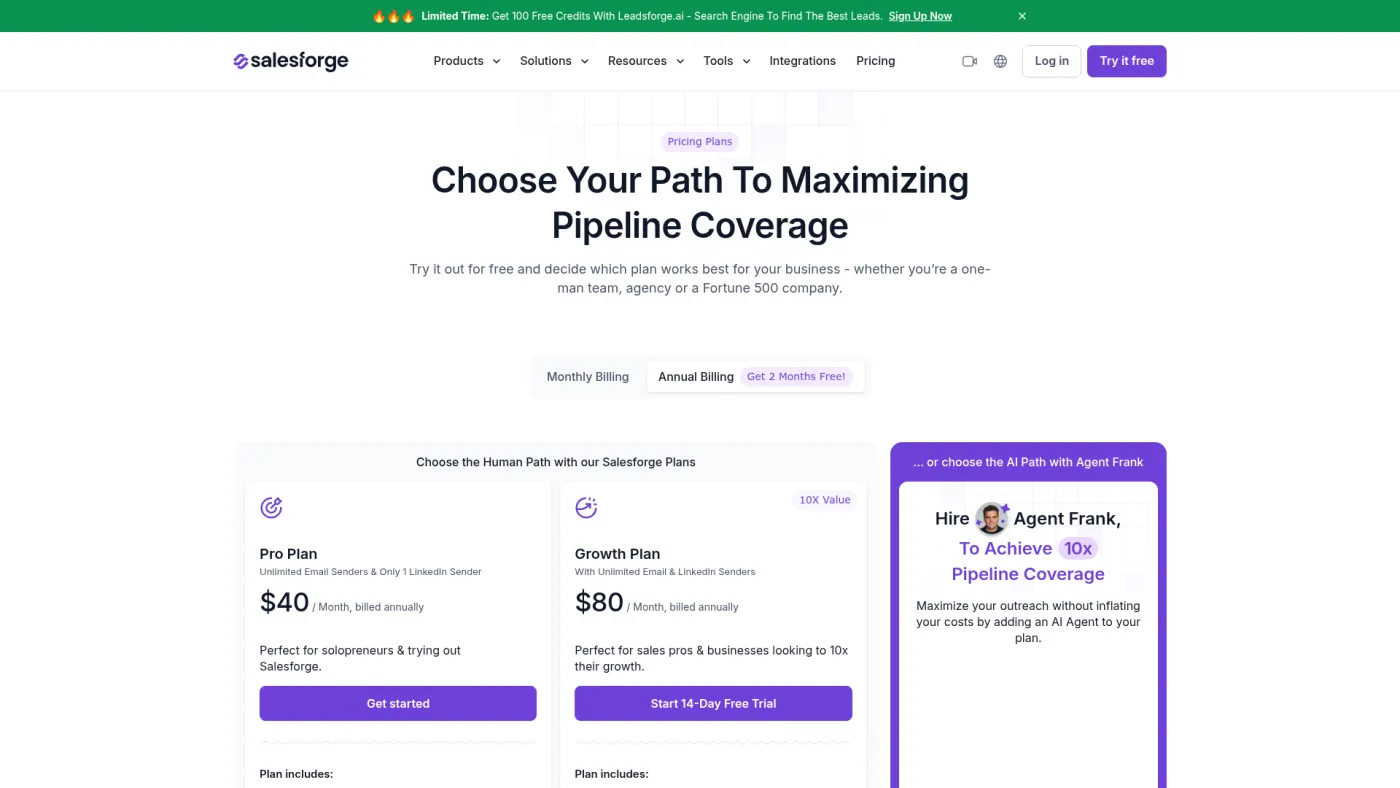
Agent Frank is positioned as an autonomous outbound agent inside the broader Salesforge ecosystem. The useful part of its public pricing is a concrete contact allowance, which gives buyers a starting denominator for a scenario model.
Salesforge's official pricing page listed Agent Frank at $499/month billed quarterly, or a $417 monthly equivalent with annual billing, and described 2,000 or more contacts per month. The page also separates other Salesforge modules, so confirm what is included in the agent price versus inbox, data or infrastructure costs.
Best for: teams evaluating an email-first agent that want a more visible commercial starting point than a custom quote.
Drawback: “contacts processed” is not an outcome. Model accepted prospects, qualified replies, human review minutes and CRM cleanup—not just the nominal allowance.
3. Reply Jason AI — best AI inside a mature sequencer
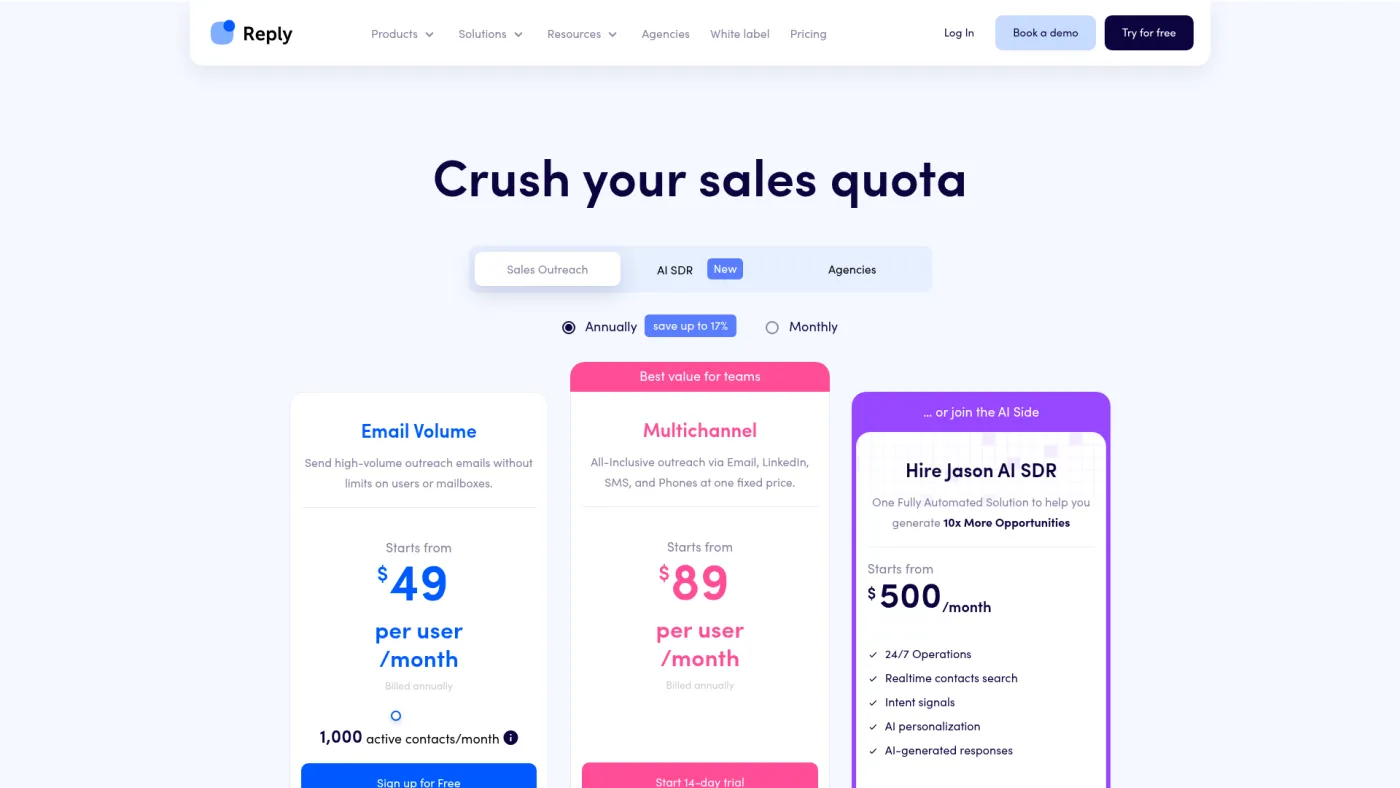
Reply has a longer history as a sales-engagement platform, and Jason AI extends that workflow toward agentic prospecting. It is the better conceptual fit when the team wants multichannel sequencing and AI under one operating surface rather than a separate black-box agent.
Reply's official pricing page showed Jason AI starting at $500/month. The same page presents standard email and multichannel products and additional AI-SDR packages, so ask for a scenario that includes the seats, channels, contact volumes and agent functions you will actually use.
Best for: teams that already understand sequencing and want an AI layer with conventional campaign controls nearby.
Drawback: overlapping product tabs can make the lowest displayed number an incomplete comparison. Require one written architecture and one total monthly/annual price.
4. Amplemarket Duo — best governed platform approach
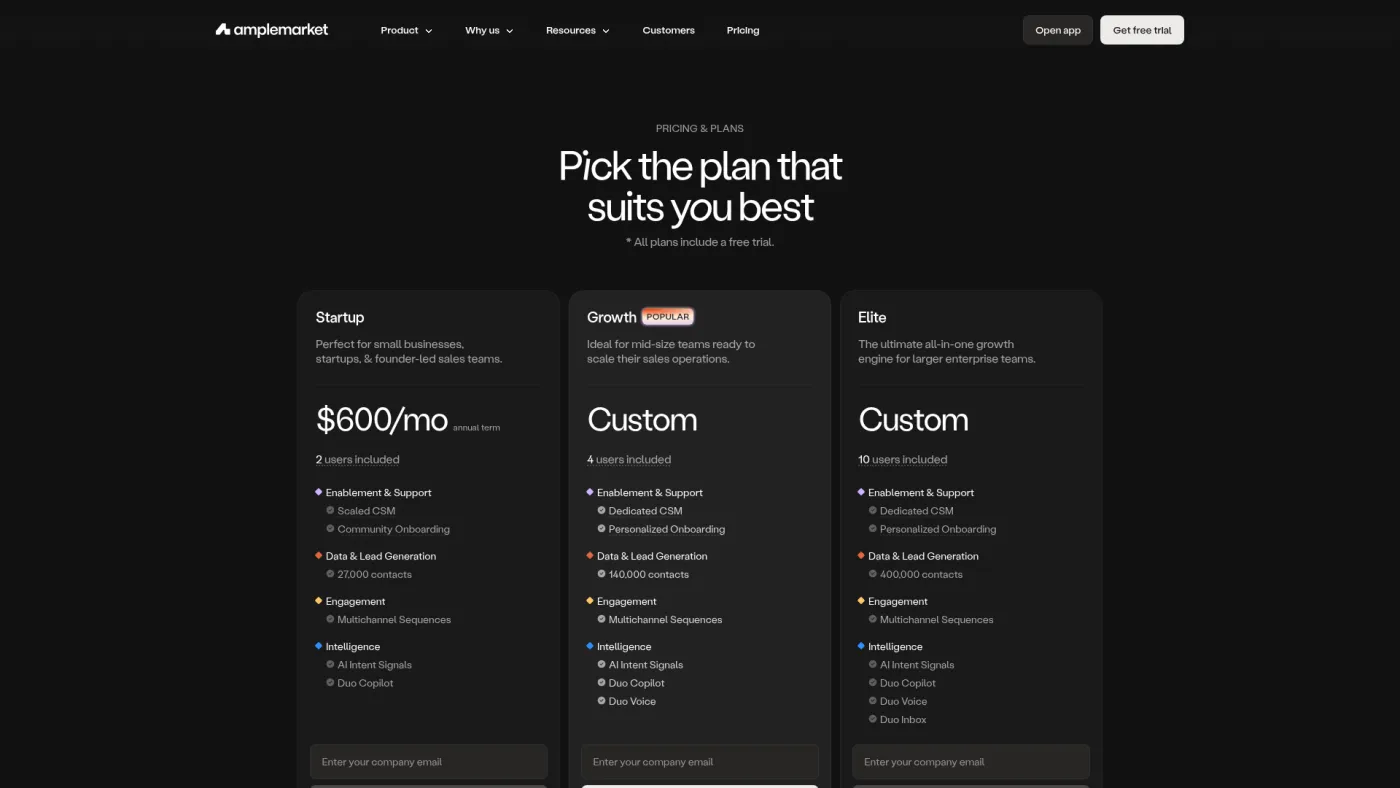
Amplemarket combines prospect data, multichannel workflows and AI assistance. Duo is positioned as an AI sales copilot/agent within that system, making Amplemarket relevant when governance and platform continuity matter more than buying a standalone bot.
Amplemarket's official pricing page showed Startup at $600/month on an annual term for two users, with Growth and Elite using custom pricing. Confirm which Duo actions, data allowances, channels, integrations and admin controls are in the selected plan.
Best for: a team that wants AI inside an integrated outbound platform and can support a structured implementation.
Drawback: an annual platform purchase is a costly way to discover that the audience or offer is not repeatable. Prove the motion and define the CRM contract first.
5. Artisan Ava — best sales-led autonomous program
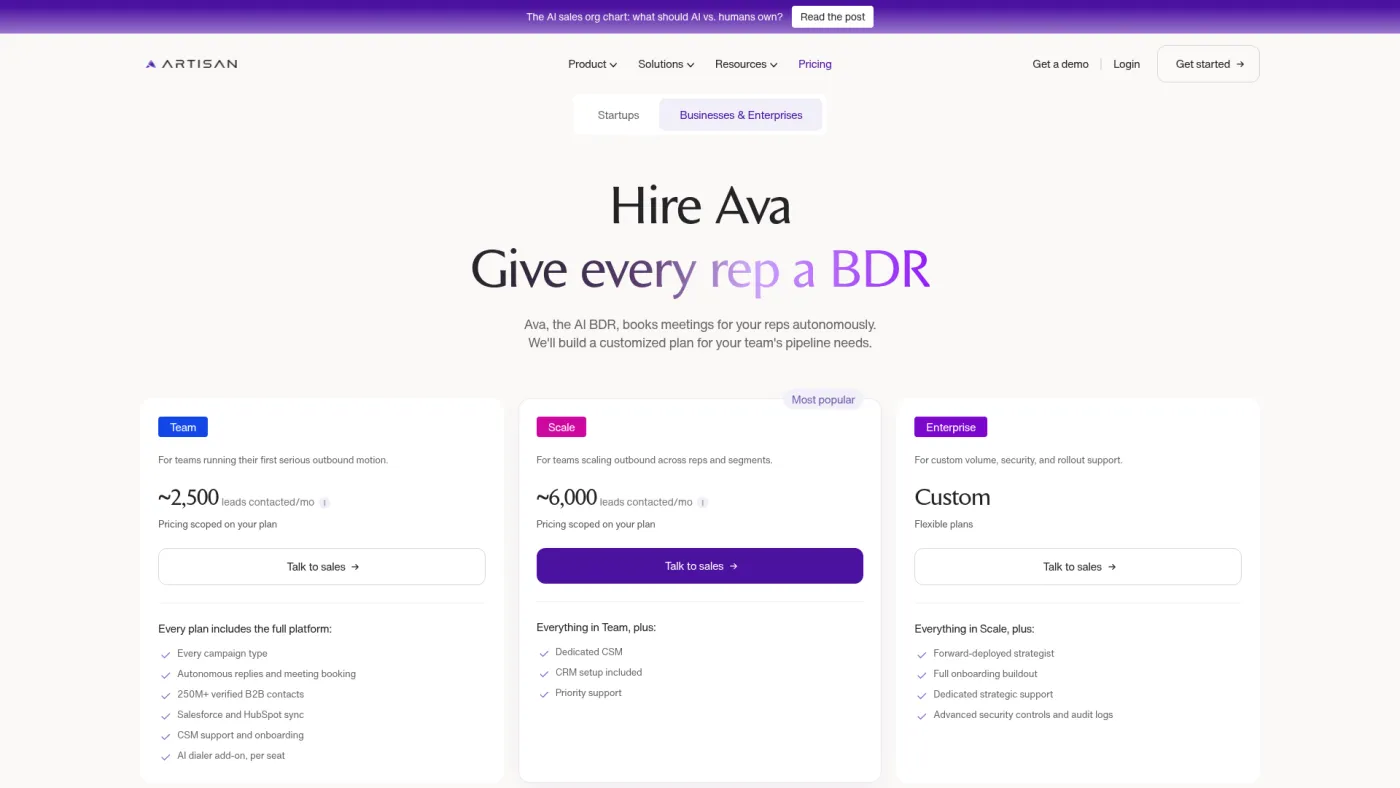
Artisan positions Ava as an autonomous business-development agent and sells through a scoped plan rather than a universal public price. Its pricing page exposed plan dimensions such as leads, mailboxes and dialer seats, which are exactly the inputs a buyer should normalize in a quote.
Artisan's official pricing page did not provide one trustworthy public starting price at the time checked. Team, Scale and Enterprise scope depends on lead volume and infrastructure. Do not substitute a reseller, forum or outdated article price for the written quote.
Best for: teams ready to evaluate a more managed, sales-led agent deployment with clear volume requirements.
Drawback: custom pricing makes desk research incomplete. The contract needs explicit data ownership, approval behavior, exclusions, human escalation, renewal and export terms.
6. 11x Alice — best high-budget managed autonomous SDR
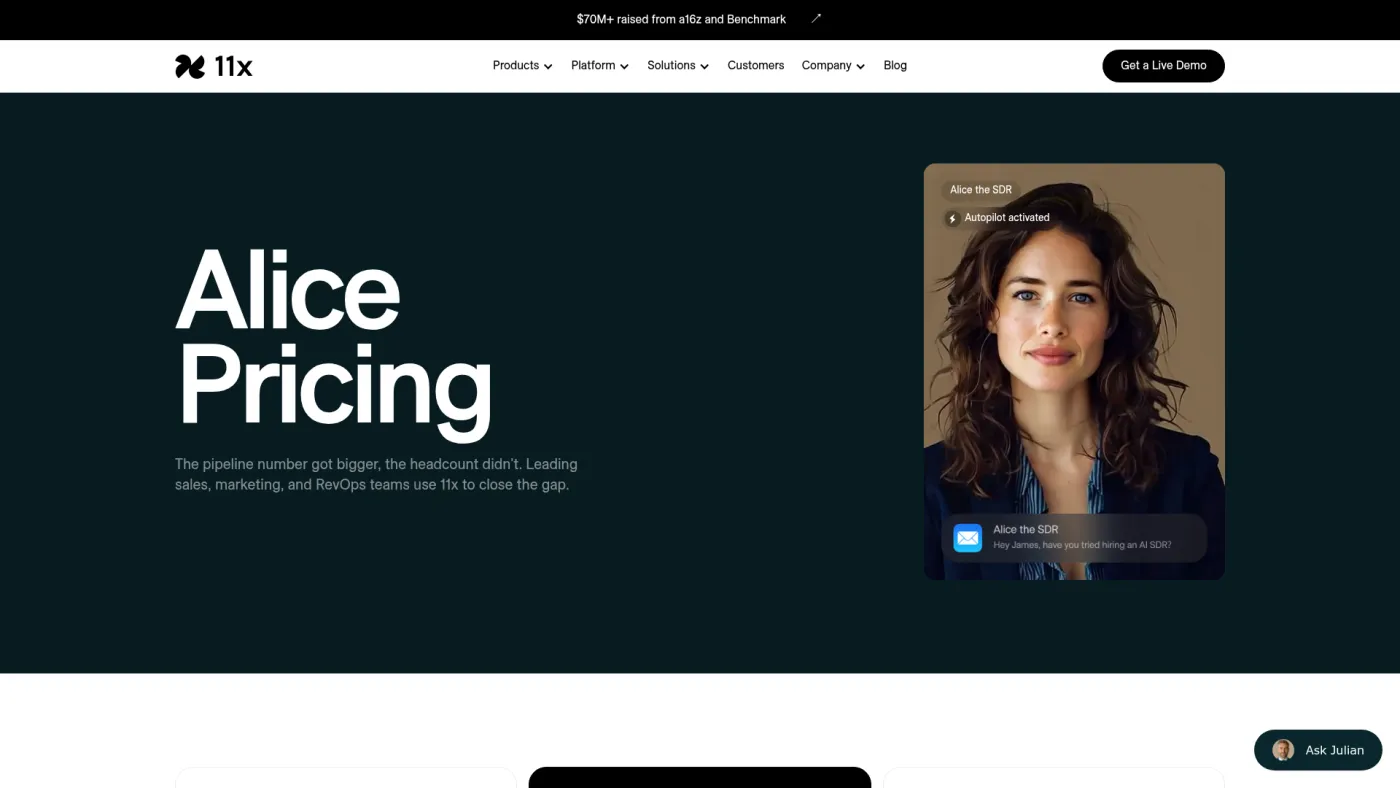
11x positions Alice as a digital worker for prospecting and engagement. It is the high-commitment option in this shortlist and should be compared against the full cost of a managed program, not against a $49 per-seat sequencer.
11x's official Alice pricing page showed Growth at $3,750/month billed annually for up to 2,000 new prospects per month; higher plans used custom pricing. Confirm the exact annual value, prospect definition, included channels, data sources and service obligations in writing.
Best for: teams with established economics and an owner who can govern a managed autonomous prospecting program.
Drawback: the annual commitment increases learning cost. A buyer needs a staged acceptance plan and an export/termination path before handing over a large workflow.
The delegation matrix: decide what the agent may own
Use this before a demo. Write one human owner and one system of record for every row.
| Step | Safe first delegation | Human ownership that remains |
|---|---|---|
| Account research | Gather evidence and propose a fit reason | Define ICP, approve sources and audit false positives |
| Contact selection | Suggest people who match role rules | Approve sensitive segments, duplicates and lawful-use policy |
| Message drafting | Draft from approved facts and templates | Approve claims, tone, proof and prohibited content |
| Sending | Execute within mailbox, timing and suppression rules | Own domains, authentication, volume, pause and incident response |
| Reply handling | Classify and draft routine next steps | Own ambiguous, legal, hostile, referral and high-value replies |
| Qualification | Score against explicit questions and evidence | Set threshold, sample errors and override outcomes |
| Booking | Offer allowed slots and write CRM state | Own routing, attendance, reschedule and handoff SLA |
If a vendor cannot explain the row-level boundary, the product is not ready to own it.
How Jan's historical operating evidence changes the evaluation
Jan has shown working sales automations, but the useful lessons are about system design—not permission to claim a current vendor benchmark.
- In a March 29, 2024 AI inbox-manager walkthrough, he explained choosing Smartlead for API access and later showed explicit reply classes such as interested, more information, referral, later and unsubscribe. That is historical implementation evidence: an agent needs discrete states and a route for each.
- In a July 1, 2024 automation walkthrough, he favored queued processing over fragile instant triggers and marked work complete only after a successful downstream response. That supports retryable jobs and observable status.
- In a July 3, 2024 AI lead-scoring system, he said the qualification bot worked well but was not always correct and discussed thresholds and next actions. That is not a current accuracy rate. It is a reason to sample errors and keep a human override.
- In an August 10, 2024 business automation explanation, he framed automation as process design spanning people, procedures and software. That remains the clearest lens for an AI SDR purchase.
The minimum viable AI-SDR pilot
Run a constrained pilot before granting broad autonomy:
- Select one narrow segment and one approved offer.
- Freeze a control group or at least a pre-pilot baseline; do not change targeting, offer and tool simultaneously.
- Limit records, mailboxes, channels and external actions.
- Require human approval for the first messages and every ambiguous reply class.
- Log source facts, generated content, tool actions, provider responses and final CRM writes.
- Sample false positives, false negatives, opt-outs, duplicate contacts and failed handoffs.
- Measure accepted prospects, qualified conversations, show rate, pipeline and operator time—not sends or generic replies.
- Define the stop condition before the pilot begins.
For message work, use the cold email generator to turn supplied evidence into an editable draft without inventing proof. It is a drafting aid, not an autonomous sender.
Credible non-agent alternatives
An autonomous agent is not the default answer.
| If the bottleneck is… | Start with… |
|---|---|
| Prospect data and a basic sequence | Apollo or the B2B lead generation software guide |
| Sending infrastructure and campaign operations | Instantly, Smartlead, or the cold email software guide |
| Custom enrichment and routing | Clay plus a visible queue and CRM contract |
| Reply drafting only | A copilot behind human approval, not a system with send permissions |
| Follow-up wording | The follow-up email generator with confirmed context and stop states |
| An unclear offer | Customer research and positioning work before another tool |
These alternatives are often cheaper and easier to debug. They also make it clearer which part of the workflow the team is learning.
When not to buy an AI SDR
Do not buy yet when:
- your CRM has no authoritative owner or lifecycle states;
- no suppression list reliably reaches every channel;
- the team cannot explain why an account or contact is in scope;
- the offer changes every week;
- no human owns replies and exceptions;
- campaign success is measured in sends, opens or raw replies;
- the vendor will not document data use, retention, permissions and export;
- the proposed contract is larger than the cost of proving the motion manually.
An agent can increase throughput. It cannot make an undefined process correct.
Final verdict
Begin with AiSDR when you need a comparatively accessible autonomous-agent evaluation, Agent Frank when email-first contact economics are easier to model, and Reply Jason AI when a conventional sales-engagement system should remain visible around the agent.
Put Amplemarket, Artisan and 11x through a written architecture and commercial review. The best sales development tool is not the one that claims the most human replacement. It is the one whose delegated work, failure modes and business outcome your team can see and own.
Frequently asked questions
What is an AI SDR?
An AI SDR is software that automates or assists sales-development work such as research, personalization, outreach, follow-up, reply handling, qualification or booking. Products vary widely in autonomy; ask which external actions they can take without approval.
How much does an AI SDR cost?
Public starting points in this comparison ranged from $250/month to $3,750/month billed annually, while some vendors use custom quotes. Total cost can also include data, mailboxes, domains, users, contacts, integrations and managed services.
Can an AI SDR replace a human SDR?
It can automate bounded tasks, but a production workflow still needs human ownership for targeting, claims, permissions, exceptions, compliance, incidents and revenue handoff. Evaluate replacement claims against a written task map.
Which metrics should an AI SDR pilot use?
Track accepted prospects, qualified conversations, meetings that occur, pipeline, revenue, operator time, opt-outs, false classifications and failed handoffs. Sends and raw replies are activity measures, not business outcomes.
What is the best alternative to an AI SDR?
Often it is a smaller stack: a clean CRM, a verified data source, a sequencer and a human-owned reply process. Add an agent only where a repeatable bottleneck is already visible.