Use-case guide
5 Best Lead Generation Tools by Job (2026)
Compare the database, finder, enrichment, orchestration, and browser-automation layers before adding another lead-generation tool.
Shortlist size
5
Publicly evidenced options with current billing notes and real website captures.
Quick verdict
Apollo is the all-in-one starting point, Hunter the focused email-discovery layer, Prospeo the broader contact-data workspace, Clay the orchestration layer, and PhantomBuster the browser-automation option that needs the strictest platform and QA controls. Do not buy a lead-generation tool until the target problem, accepted record and handoff owner are specific.
Affiliate economics do not determine inclusion or order. Official public pricing and website captures were checked September 24, 2026. This is a documentation-led stack comparison; no shared coverage, ROI, scraping-safety, or meeting-booked benchmark was run.
Side-by-side
Lead-generation tools compared by job
| Tool | Best for | Public starting point | Limit to model | Main drawback |
|---|---|---|---|---|
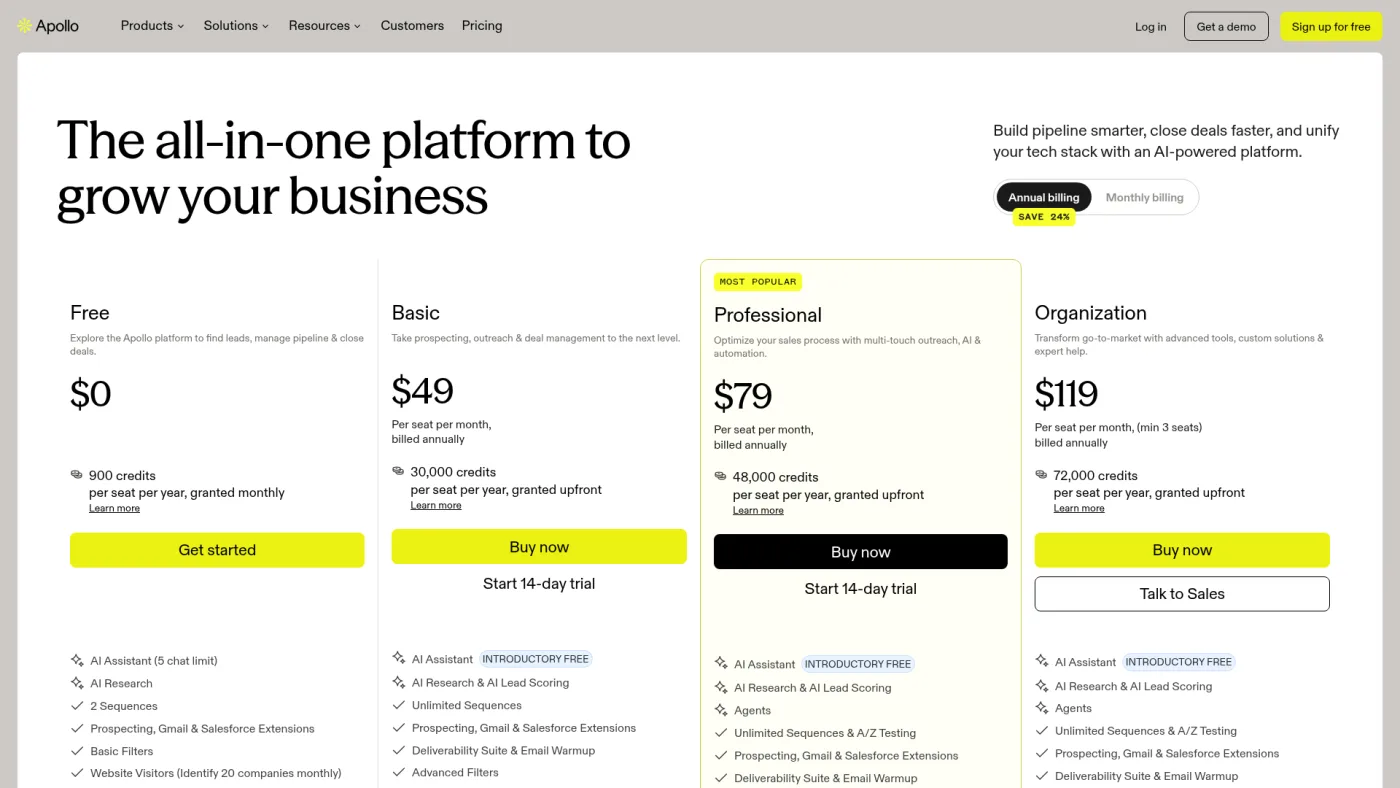
| Apollo | A small sales team that wants prospect data and activation in one suite | $49/user/month for Basic, billed annually | Basic grants 30,000 credits per seat per year; phone, enrichment, dialing and research actions can consume different amounts. | A broad suite can blur the boundary between a record found, a record accepted and a prospect ready for activation. |
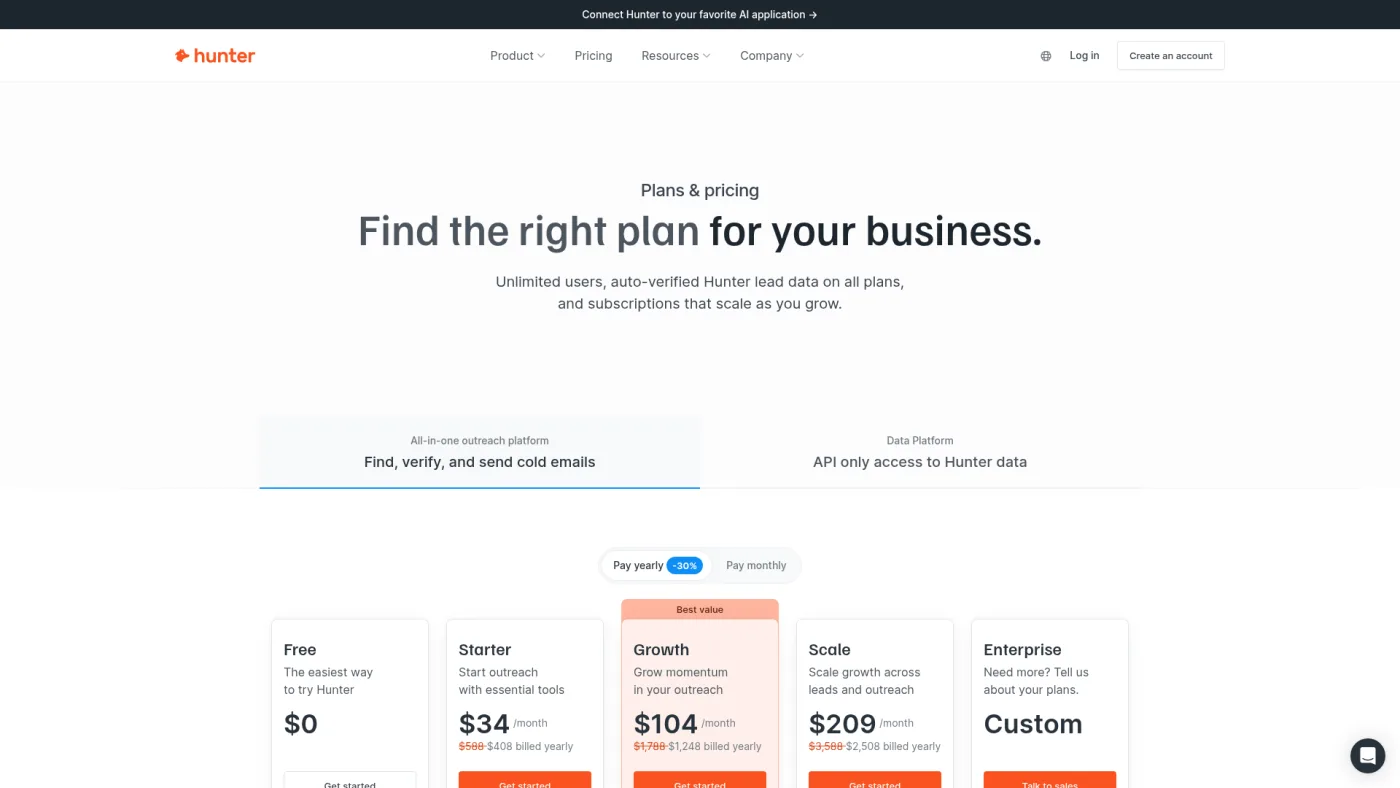
| Hunter | Focused work-email discovery and verification from known people or domains | $49/month for Starter, or $34/month equivalent billed yearly | Starter includes 2,000 monthly credits on monthly billing; coverage and verification still vary by record and market. | Hunter does not replace account selection, rich firmographic research or a serious activation system. |
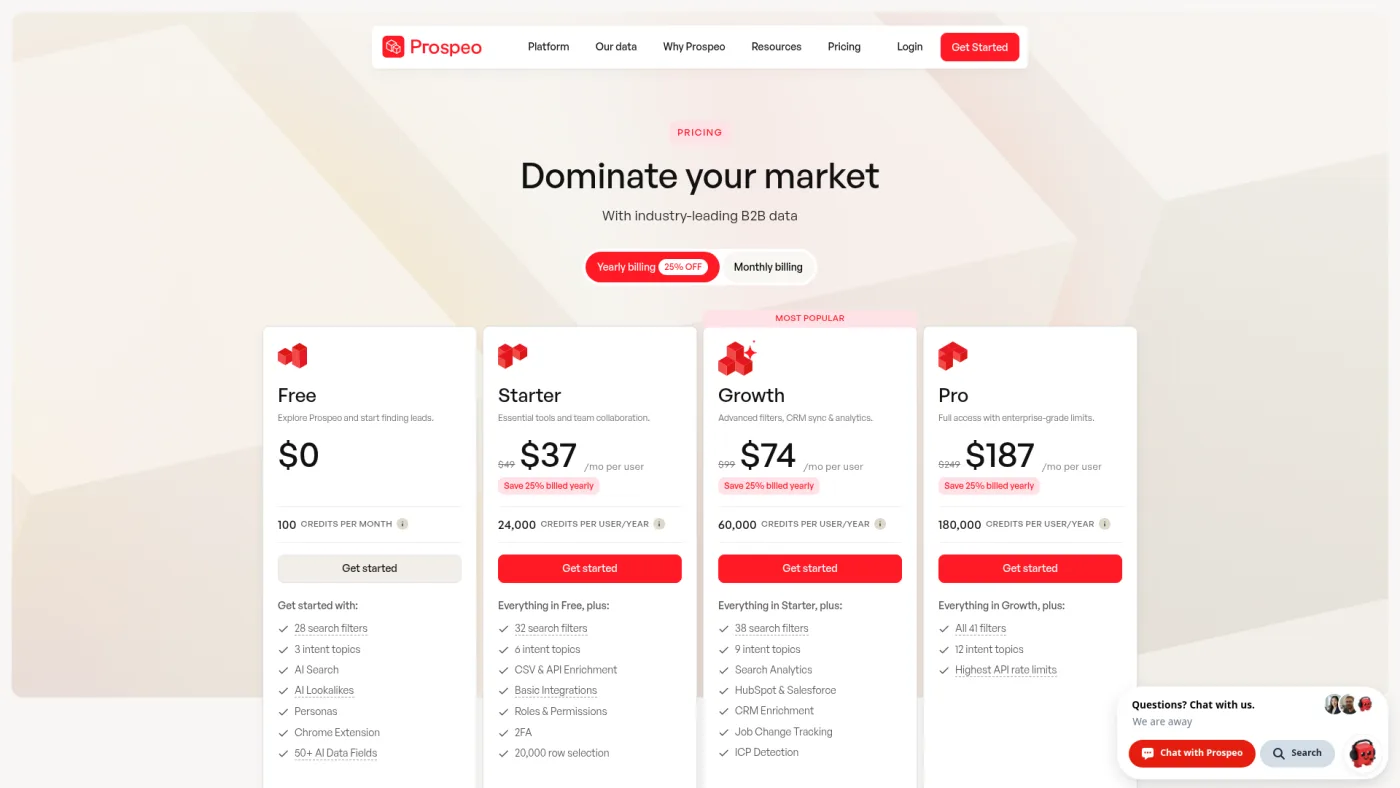
| Prospeo | Contact search and enrichment with broader filters, AI fields and CRM sync | $49/user/month for Starter, or $37/user/month equivalent billed yearly | Yearly Starter grants 24,000 credits per user up front; credits reset at renewal and mobile results cost more than emails. | Annual credit grants and per-user pricing can outgrow a sporadic campaign cadence, especially when phone enrichment enters the mix. |
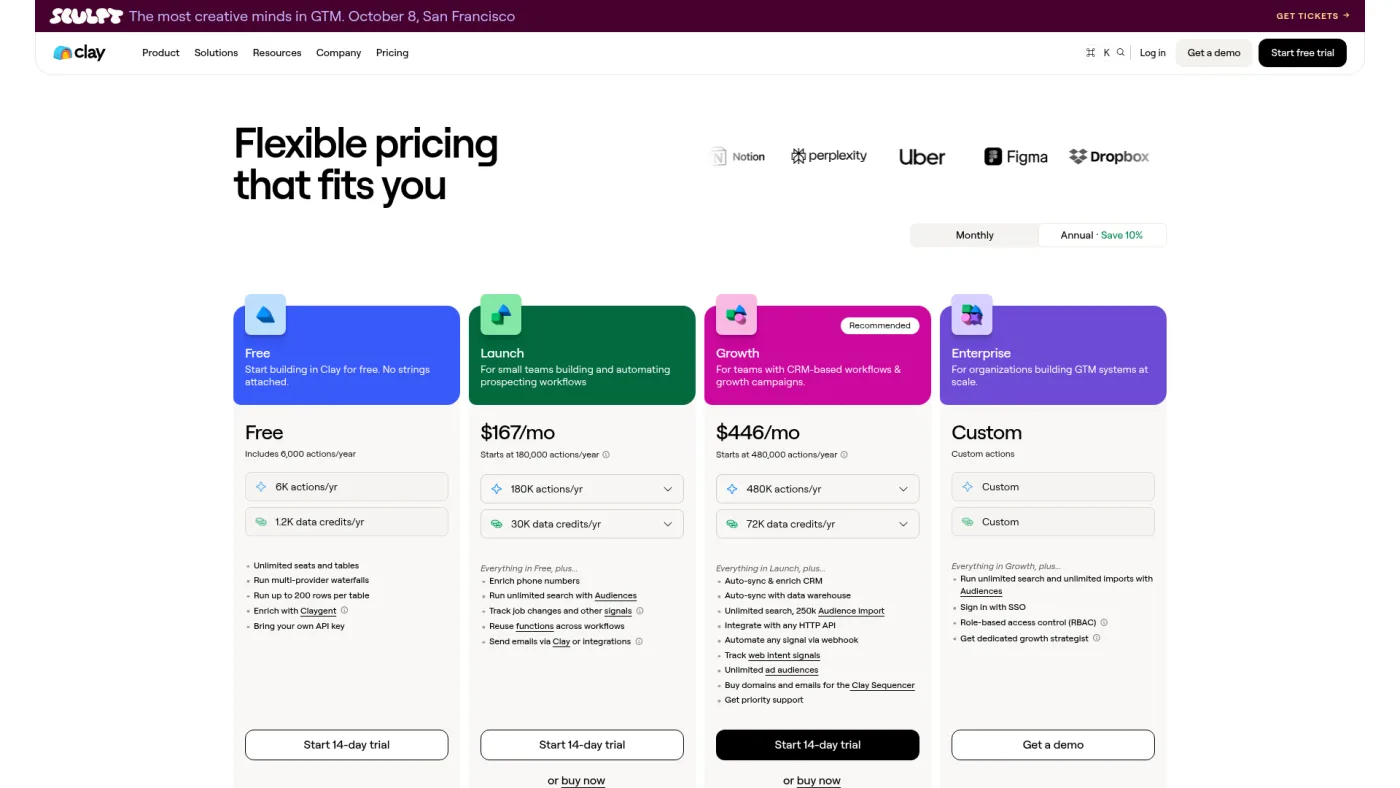
| Clay | Teams orchestrating several data, research and routing providers | $185/month for Launch, or $167/month equivalent billed yearly | Plan access, Actions and Data Credits are separate; the starting workflow must be modeled across all three layers. | A powerful workbench increases maintenance and failure-surface area when the team has not standardized the research and qualification process first. |
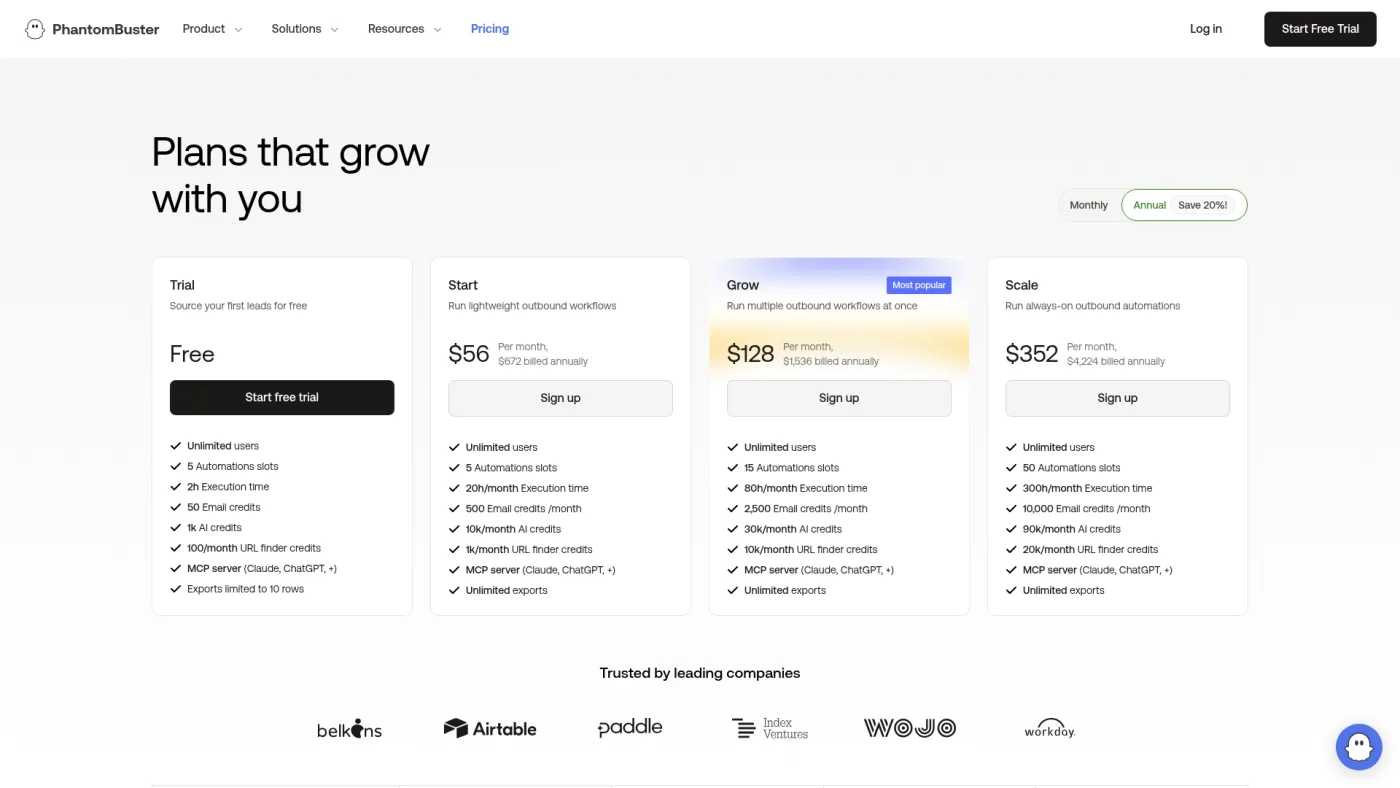
| PhantomBuster | Browser-based lead collection and repeatable web workflows with human review | $56/month equivalent for Start, billed $672 yearly | Start includes five automation slots, 20 execution hours, 500 email credits and 1,000 URL-finder credits per month. | Browser automation and extraction can create platform, legal, account and data-quality risk; a plan limit is not a safety guarantee. |
Evidence method
How this shortlist was built
Reviewed September 24, 2026. Lead generation spans targeting, discovery, enrichment, orchestration and activation. Products in different layers are not direct substitutes, and public database-size or accuracy claims are not controlled comparison results.
- 1
Mapped each product to the job it primarily replaces or coordinates instead of treating every lead tool as an interchangeable database.
- 2
Verified current public entry price, billing cadence, core usage unit, relevant limit and material platform or workflow drawback.
- 3
Captured one authentic 1920×1080 public pricing page per option, visually inspected it, and stored an uncropped 1400×788 local asset.
- 4
Kept vendor claims, historical operator evidence and editorial inference separate; no score or verdict changed for this shortlist.
The shortlist
Five options across the lead-generation stack
Apollo
Best for: A small sales team that wants prospect data and activation in one suite
Apollo is the most complete single-product starting point here. It can reduce handoffs between database search, enrichment and outreach, but the team still needs a visible acceptance gate before a contact enters a sequence or CRM workflow.
- Public price
- $49/user/month for Basic, billed annually
- Constraint
- Basic grants 30,000 credits per seat per year; phone, enrichment, dialing and research actions can consume different amounts.
Drawback: A broad suite can blur the boundary between a record found, a record accepted and a prospect ready for activation.
Hunter
Best for: Focused work-email discovery and verification from known people or domains
Hunter is the specialist choice when the team already knows whom it wants and needs a clean email-finding step. Its narrower scope can be an advantage: targeting, data acceptance and sending remain separate, replaceable responsibilities.
- Public price
- $49/month for Starter, or $34/month equivalent billed yearly
- Constraint
- Starter includes 2,000 monthly credits on monthly billing; coverage and verification still vary by record and market.
Drawback: Hunter does not replace account selection, rich firmographic research or a serious activation system.
Prospeo
Best for: Contact search and enrichment with broader filters, AI fields and CRM sync
Prospeo fills the middle ground between a single email finder and a large all-in-one sales suite. It suits teams that want list discovery, enrichment and CRM handoffs while retaining a clear credit model and a separate activation decision.
- Public price
- $49/user/month for Starter, or $37/user/month equivalent billed yearly
- Constraint
- Yearly Starter grants 24,000 credits per user up front; credits reset at renewal and mobile results cost more than emails.
Drawback: Annual credit grants and per-user pricing can outgrow a sporadic campaign cadence, especially when phone enrichment enters the mix.
Clay
Best for: Teams orchestrating several data, research and routing providers
Clay belongs in the stack when the problem is provider orchestration rather than one missing field. It can research, enrich, transform and route records, but it needs a technical owner and an explicit stop condition before a row becomes sales-ready.
- Public price
- $185/month for Launch, or $167/month equivalent billed yearly
- Constraint
- Plan access, Actions and Data Credits are separate; the starting workflow must be modeled across all three layers.
Drawback: A powerful workbench increases maintenance and failure-surface area when the team has not standardized the research and qualification process first.
PhantomBuster
Best for: Browser-based lead collection and repeatable web workflows with human review
PhantomBuster is the automation option when the source workflow lives in public web interfaces rather than a clean database API. Use it only with platform-aware limits, lawful-use review, visible failures and a manual acceptance gate before outreach.
- Public price
- $56/month equivalent for Start, billed $672 yearly
- Constraint
- Start includes five automation slots, 20 execution hours, 500 email credits and 1,000 URL-finder credits per month.
Drawback: Browser automation and extraction can create platform, legal, account and data-quality risk; a plan limit is not a safety guarantee.
Original decision aid
Build the stack around the bottleneck
| Situation | Start with | Why |
|---|---|---|
| The team needs one database and activation suite | Apollo | Keep one explicit gate between data discovery and sequence enrollment so breadth does not become automatic activation. |
| The target accounts and people are already known | Hunter | A focused finder can solve the missing-email step without replacing the rest of the stack. |
| Broader contact research and CRM handoff matter | Prospeo | Use its search and enrichment surface while modeling per-user credits against campaign cadence. |
| Several sources need research, fallbacks and routing | Clay | Pay for orchestration only when someone owns provider order, transformations, stop conditions and QA. |
| The source requires browser automation | PhantomBuster, carefully | Review platform terms, lawful use, account risk, limits and failure handling before any extraction or activation. |
Historical operator evidence
A specific prospect problem comes before the tool
In a June 9, 2023 cold-email video, Jan argued that outbound needs one specific prospect problem and offer rather than a generic service menu. He later judged campaign work through the chain from responses to meetings and closes. Those are historical operating principles, not current conversion benchmarks. Applied here, they mean choosing a tool only after the target problem, accepted lead and downstream outcome are defined.
Watch the timestamped sourceQuality gate
Do not add another lead tool when…
- — The target segment and prospect problem are broad enough that almost any record appears acceptable.
- — Records can reach outreach without verification, suppression, ownership and a visible acceptance decision.
- — The buyer is comparing database size instead of usable results in the exact geography, industry and titles that matter.
- — No one owns missing data, duplicate identities, stale records, platform risk and rollback.
- — The team cannot follow positive replies through meetings, opportunities and revenue without double-counting activity.
Final verdict
Use Apollo when one suite genuinely simplifies the operating model, Hunter for focused email discovery, Prospeo for a broader data workspace, Clay for controlled multi-source orchestration, or PhantomBuster for carefully governed browser automation. If the bottleneck is an unclear offer, acceptance rule or handoff, software will only automate the ambiguity.
Keep exploring
Related use cases guides
Best tools for managing prospects
Tools for keeping prospect context, ownership, status, replies, and next actions visible across the outbound motion.
Open guideBest tools for automating prospecting
Automate list building, enrichment, sequencing, and routing while preserving review points where mistakes become expensive.
Open guideBest tools for managing follow-ups
Compare sequencers and engagement tools that keep timing, branching, replies, and ownership from becoming spreadsheet work.
Open guideBest tools for customer retention workflows
Outbound tools are not customer-success platforms, but signal, CRM, automation, and content layers can support expansion and re-engagement workflows.
Open guide