
Postiv is our first pick for agencies that want a separate LinkedIn content workspace for each client, with writing context, brand assets and approvals together. Supergrow is a relevant alternative for a centralized agency workflow with client workspaces. AuthoredUp is worth considering when the agency already writes the content and mainly needs editorial collaboration across profiles.
This guide compares Postiv, Supergrow and AuthoredUp for managing paid client content. If you are an agency owner publishing for your own business, start with our LinkedIn content tools guide. If your task is coordinating colleagues at one company, use the whole-team posting comparison.
Disclosure: OutboundXYZ's Jan van Musscher co-founded Postiv. These are editorial workflow recommendations based on official pages checked September 14, 2026. We have not tested client-data isolation, permission enforcement or comparative writing quality. The images below are real public homepage captures from that date.
Compare the billing unit before the price
| Tool | Best fit | Separation described publicly | Collaboration | Price basis checked September 14 | Main limitation |
|---|---|---|---|---|---|
| 1. Postiv | A distinct content system for every client | Separate workspace, client-specific voice, knowledge and brand assets | Agency admin access; client collaboration and approval workflows | Agency: $99 per client workspace per month displayed | Confirm profile allowances, contract terms and operating limits for each workspace |
| 2. Supergrow | Managing multiple client workspaces centrally | Dedicated client workspaces and per-client personalization | Team invitations, roles and content approvals described | Agency-specific total not verified; obtain a quote | Do not substitute an individual or four-account team price for an agency quote |
| 3. AuthoredUp | An agency with an existing writing process | Separate drafts, analytics and settings per profile | Draft collaboration and roles; collaborators without connected profiles are described as free | Business: $14.95 per connected profile per month; minimum three, monthly billing | Draft review is not verified here as an enforced pre-publication approval gate |
A client workspace, a publishing profile and a collaborator are different units. One client may have several people publishing. An agency may also have editors who never connect their own LinkedIn profile. Count each category before comparing offers.
1. Postiv: our first pick for separate client content systems
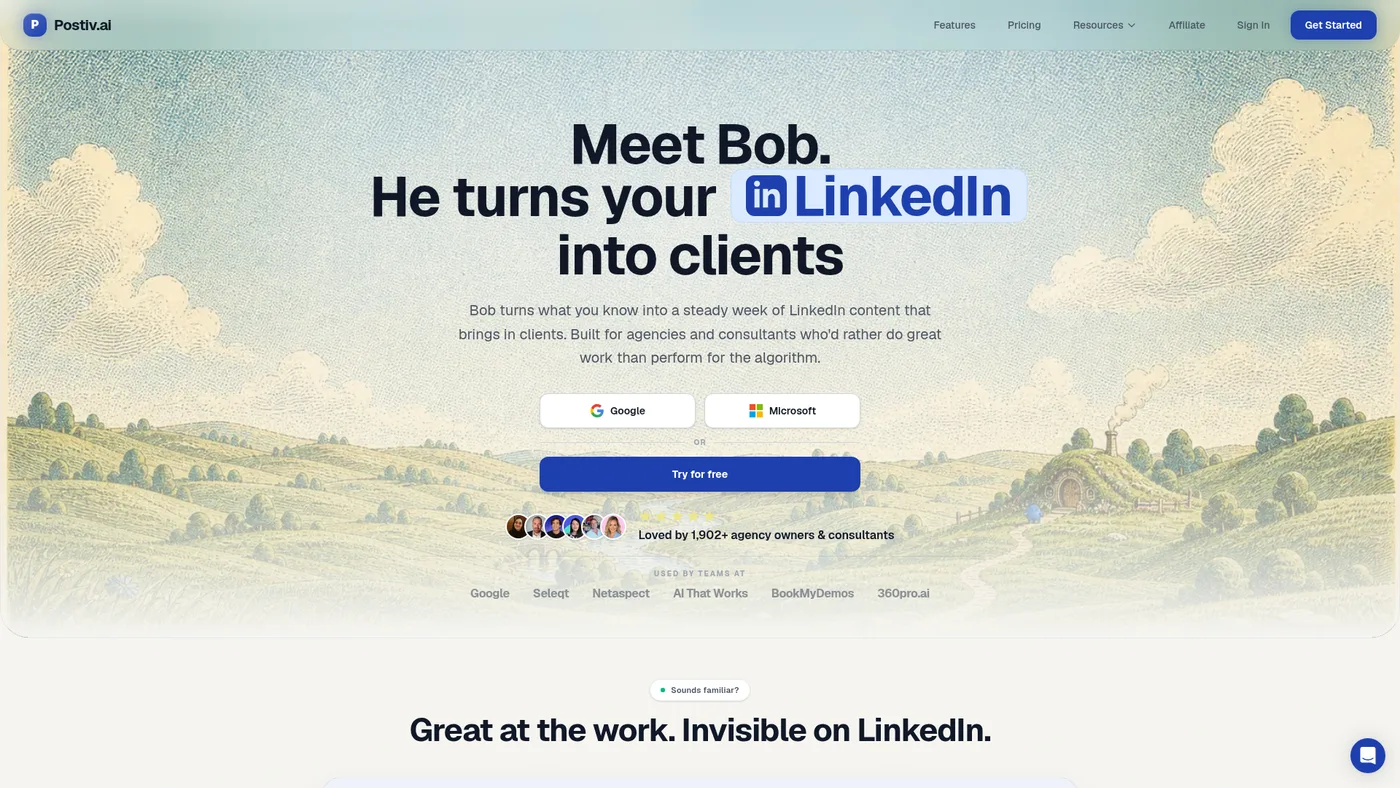
Postiv public homepage, September 14, 2026.
Postiv's Agency offer explicitly describes a separate workspace for every client, client-specific voice and knowledge, branded assets, agency admin access and client collaboration with approvals. That matches the daily job of an agency managing different businesses with different perspectives.
Consider an illustrative three-client setup: a consultant, a software founder and a service agency. Each has its own facts, writing preferences, visual identity and approval owner. The useful question is whether the workspace keeps that context attached to the right client's work from the initial brief through publishing. A shared folder full of unlabelled prompts is not an adequate substitute for that organization.
Why Postiv leads this shortlist: its documented agency package puts the client workspace at the center of the commercial offer and includes the surrounding creation process. That is a clear fit for an agency selling recurring LinkedIn content rather than access to a scheduler alone. Its visual features also matter when the service includes carousels alongside text.
What to verify: confirm the number of publishing profiles covered in each client workspace, approval configuration, administrator access and what happens during client offboarding. A marketing description of separate workspaces does not establish technical isolation. Do not assume the Team plan's advertised profile allowance describes every detail of the Agency offer.
See Postiv's current Agency offer and our carousel comparison if visual content is part of your service.
2. Supergrow: an alternative for centralized agency operations
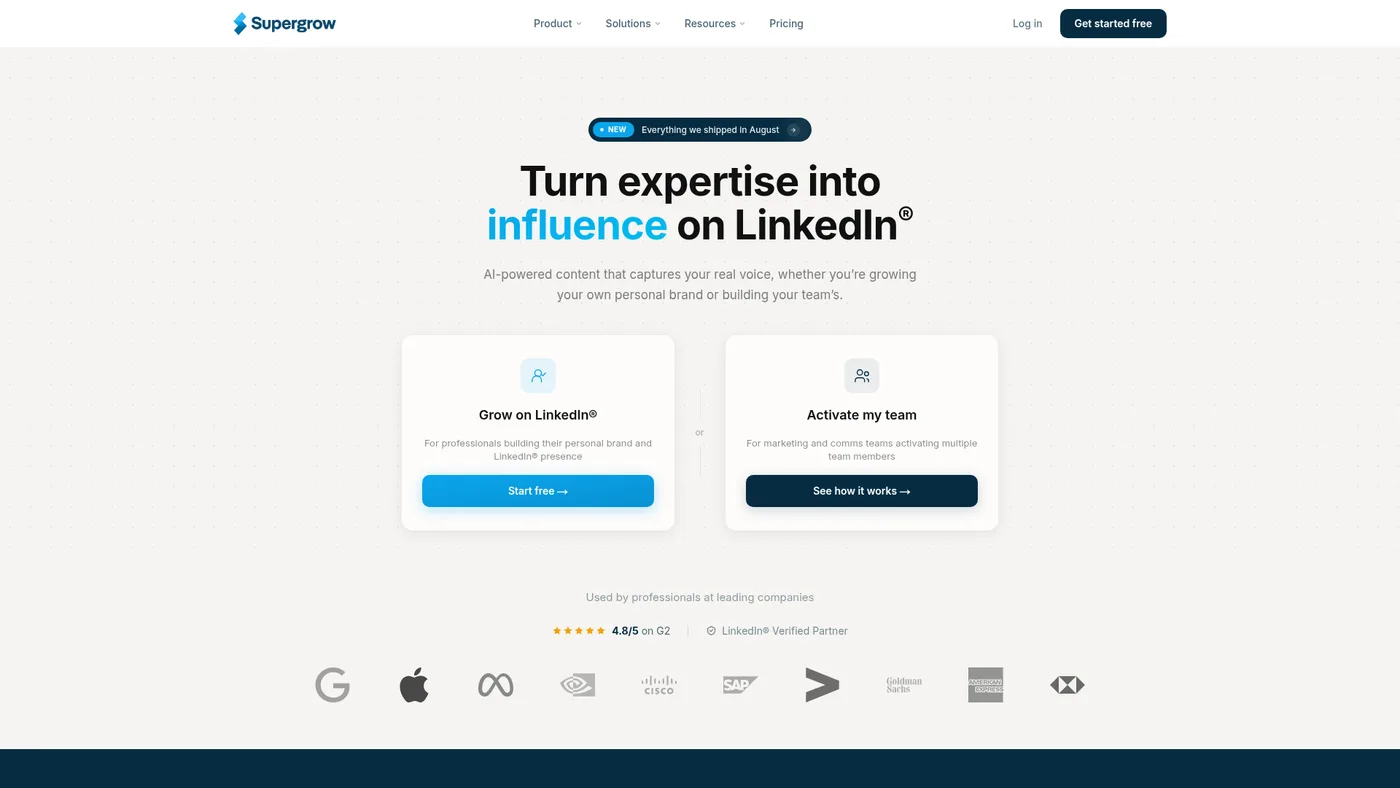
Supergrow public homepage, September 14, 2026.
Supergrow's agency page describes dedicated client workspaces, switching between clients, a centralized content calendar and team members with assigned roles. It also describes client-specific footers, calls to action and writing styles. Those details make it relevant to the same multi-client problem.
The page says clients can join through an invitation process without giving the agency their LinkedIn credentials. That is a useful workflow to investigate during a demo; it is a vendor statement, not our assessment of the security implementation. Ask to see the exact connection, access and revocation steps your client will encounter.
Supergrow is a sensible trial candidate when the agency wants to coordinate drafts and publishing across several clients from one operational view. Confirm whether the quote covers your number of client workspaces, connected profiles, collaborators and required approvals.
The limitation: we did not verify an agency-specific total from the reviewed pricing pages. A low individual-plan price is not a comparable agency quote. Its public Teams FAQ also contains inconsistent annual pricing, so this guide does not extrapolate those figures into a client-management cost.
3. AuthoredUp: an editorial option with profile-based billing
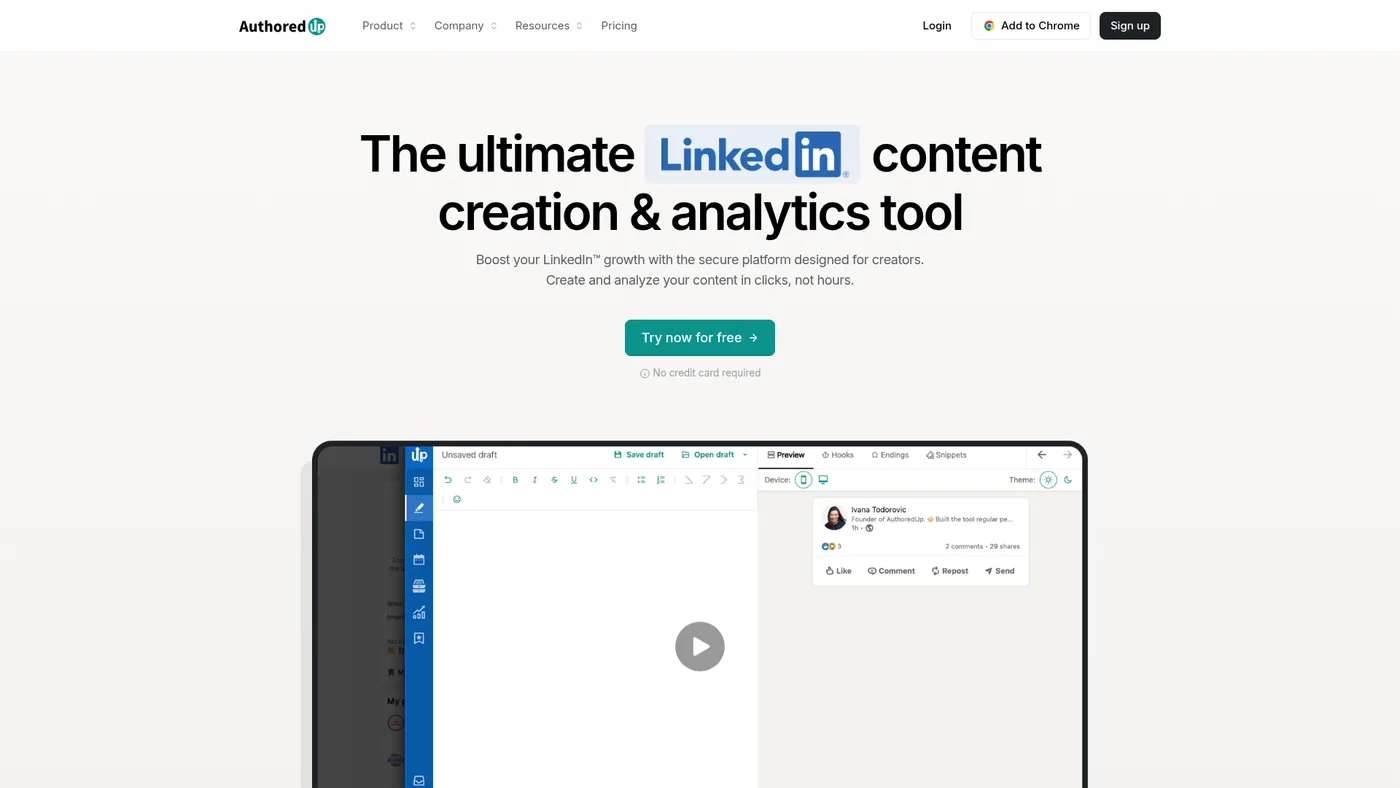
AuthoredUp public homepage, September 14, 2026.
AuthoredUp's Business plan describes multiple profiles, organization management, team analytics and draft collaboration. Its feature table says drafts, analytics and settings remain separate per profile and that agencies can manage multiple clients' profiles and associated company pages.
This is useful when your agency already has a writing process and needs an organized editing and publishing layer. The editor, preview, snippets and draft storage can support a human-led service. We are not treating it as a verified substitute for every AI-generation or visual feature in the other products.
Billing is per connected LinkedIn profile, with a minimum of three. The page describes unlimited invitations and no extra charge for managers or ghostwriters who do not connect their own profiles. That distinction can make a substantial difference for an agency with several editors but relatively few publishing clients.
The limitation: the reviewed material describes collaboration and roles, but it does not establish the exact approval enforcement your client may require. Verify whether a draft can be published before the intended reviewer has approved it, and from which interfaces.
A three-client cost worksheet
Assume three clients, one LinkedIn publishing profile per client and an agency editor. These figures are arithmetic examples using public monthly displays, not equivalent feature bundles or quotations.
| Option | Calculation | What the calculation leaves unresolved |
|---|---|---|
| Postiv Agency | 3 workspaces × $99 = $297/month | Confirm profiles, usage and terms per workspace |
| Supergrow | Quote required | Client workspaces, accounts and collaborator allowances |
| AuthoredUp Business | 3 profiles × $14.95 = $44.85/month | Required approval behavior and any separate creation tools |
The price gap is a reason to examine scope carefully. If your agency only needs editorial organization, the broader platform may be unnecessary. If your deliverable includes planning, voice context and visual production, account for the other tools and work needed to complete those tasks. This guide does not establish which option has the lowest total operating cost.
Define the client handoff before buying
Use a non-sensitive sample client and verify this sequence during a trial: create the workspace or profile, add approved facts, draft a post, invite the reviewer, request a change, approve the final version and confirm its destination. Then remove a collaborator and check the resulting access. Repeat the same scenario in every candidate.
In his June 12, 2024 video, Jan described the difficulty of fulfilling broad client promises and emphasized repeatable delivery. Applying that lesson here means deciding what your LinkedIn service includes and who owns each step before choosing software. It is historical operating context, not a claim that he ran the comparison above. Watch the source passage.
Which should your agency choose?
Start with Postiv when you want a client-specific content system that includes the creation workflow. Evaluate Supergrow for centralized client operations and AuthoredUp for profile-based editorial collaboration. Keep the decision tied to the service you actually deliver, and use our repurposing guide when turning client source material into posts is the main bottleneck.